
Your tax situation might seem a little gloomy this year, but there are a lot of bright sides to look up to if you know where to search. The Affordable Care Act (ACA) is one of those benefits you can take advantage of, especially when you complete Form 8962. The ACA gives families tax credits they can use right away to help pay for health insurance bought through government marketplaces.
If your estimated income is between 100% and 400% of the federal poverty level (FPL) for your household, you could be eligible for the premium tax credit (PTC). The PTC is a refundable tax credit that helps you cover the premiums of your health insurance purchased through the health insurance marketplace, thereby reducing your monthly payment.
What Is Form 8962?
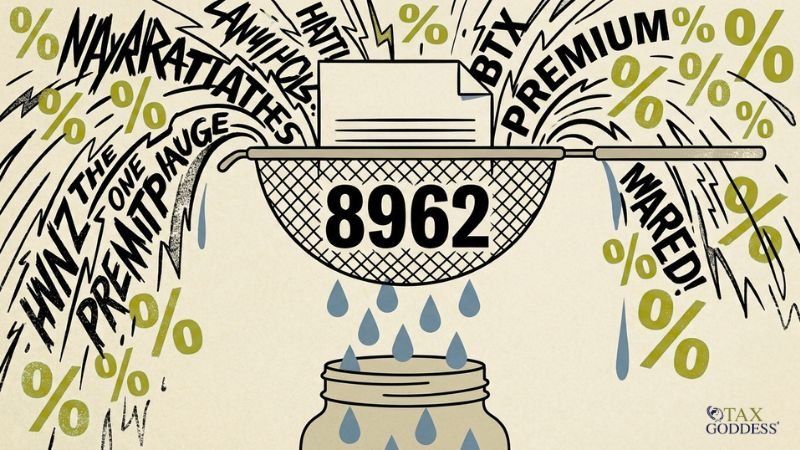
This form is used to calculate the amount of premium tax credit you qualify to claim if you purchased health insurance through the marketplace. It tells you how much credit you are qualified to receive and whether you owe the taxes for receiving too much in advance premium tax credit (APTC).
The primary purpose of the form is to allow taxpayers to reconcile their PTC amount with their federal income tax return. Reconciling ensures that the federal government paid the correct amount to your insurer based on your actual year-end income, rather than just the estimated income you provided during enrollment.
Eligibility Criteria for 2026
While these forms offer significant opportunities to reduce your tax burden, they’re not for everyone. You generally qualify to use Form 8962 if you:
- Enrolled in a qualified health plan through the Marketplace.
- Received a Form 1095-A, the health insurance marketplace statement, documenting your coverage.
- Are not eligible for employer-sponsored coverage that is considered “affordable”.
- Are not filing as Married Filing Separately, unless you meet specific exceptions like being a victim of domestic abuse.
You cannot use this form if you receive health insurance from a private insurer (documented on Form 1095-B) or through an employer (documented on Form 1095-C).
The Return of the “Subsidy Cliff”
A critical shift for the 2026 tax year is the expiration of the “enhanced” subsidies originally provided by temporary federal legislation. In 2026, the “subsidy cliff” returns. This means that if your household income is more than four times the federal poverty level, you will lose all government help to pay for your health insurance.
For the 2026 plan year, eligibility is based on the 2025 poverty guidelines. For a single individual, the 100% FPL threshold starts at $15,650, while the 400% “subsidy cliff” occurs at an income of $62,600. For a family of two, these limits are $21,150 for 100% and $84,600 for 400%. For a family of three, the eligibility range is between $26,650 and $106,600, and for a family of four, it is between $32,150 and $128,600.
Important 2026 Repayment Note: Starting in tax year 2026, the “One Big Beautiful Bill” (H.R. 1) has removed the previous caps on repaying excess advance payments. If your actual income is more than estimated and you are above the 400% threshold, you may have to repay the total difference between your advance payments and your actual allowable credit.
Using the 0% Tax Bracket and HSAs
Strategic tax planning can help you get the most out of your tax credits and avoid a massive jump in insurance costs in 2026.
If your income is close to the cutoff (400% of the federal poverty level), you can use a “Tax Gap” strategy to stay eligible for help. For example, if you put money into a Health Savings Account (HSA), the IRS lowers your “official” income (MAGI) by that same amount. This move can pull your income back below the “cliff,” potentially saving you thousands of dollars in insurance bills while keeping you in a better tax bracket.
Furthermore, if your income is low enough to qualify for the 0% capital gains rate, you might consider tax-gain harvesting. This involves intentionally selling appreciated assets to “lock in” profits at a 0% federal tax rate while you are in a lower bracket. This resets your cost basis higher for the future without increasing your current tax liability.
What Happens If I Don’t File Form 8962?
If you receive an APTC, you must file a federal income tax return that includes Form 8962, even if you are not otherwise required to file. Failing to do so is a “failure to reconcile,” which can lead to:
- Immediate Rejection: The IRS will likely reject your electronically filed return if the form is missing, but their records show you received a subsidy.
- Loss of Future Credits: You may be disqualified from receiving premium tax credits for the following year.
- Refund Delays: A missing form will stop the processing of your return and delay any refund you are owed.
Detailed Filing Instructions
To ensure you fill out the form correctly, follow these structured steps:
- Part I: Annual and Monthly Contribution Amount: Enter your tax family size and calculate your MAGI. You will determine your household income as a percentage of the federal poverty line, which sets your “applicable figure” for how much you are expected to contribute toward your premiums.
- Part II: Premium Tax Credit Claim and Reconciliation: Compare your allowed PTC against the advance payments already made. If your allowed credit is higher, you will see a Net Premium Tax Credit on Line 26, which increases your refund.
- Part III: Repayment of Excess Advance Payment: If you received more in advance than you were eligible for, you must calculate the repayment amount here. Be extremely careful in 2026, as you may owe the full amount back if your income exceeds the 400% limit.
- Part IV & V: Allocations and Marriage: Use these sections if you share a policy with someone in another tax household or if you were married during the year, which can often reduce repayment liabilities through an alternative calculation.
If My Tax Return Was Rejected, Can I Start Over?
If the IRS rejects your return, do not panic. It is usually because of a simple math error or a missing Form 8962. You should correct the errors and resubmit as early as possible. Double-check your entries against your Form 1095-A to ensure all numbers match exactly what the Marketplace reported.
Key Takeaway
Filing Form 8962 is more than just a paperwork requirement; it is the only way to officially lock in your health insurance subsidies and prevent a massive, unexpected tax bill. If you received any help paying for your insurance this year, this form is your key to keeping those thousands of dollars in your pocket.
But why stop there? Beyond health credits, the tax code is filled with “hidden” opportunities to slash your 2026 tax bill. At Tax Goddess, we build shields to protect your wealth. Our team has already saved our clients over $2.05 billion, and we want to help you discover every deduction you’ve been missing.
Disclaimer: Tax laws are subject to change. This content is for educational purposes and does not constitute formal tax or legal advice. Always consult with a qualified tax professional regarding your specific situation before implementing any strategies.
Are you ready to stop overpaying the IRS?