Key Takeaways
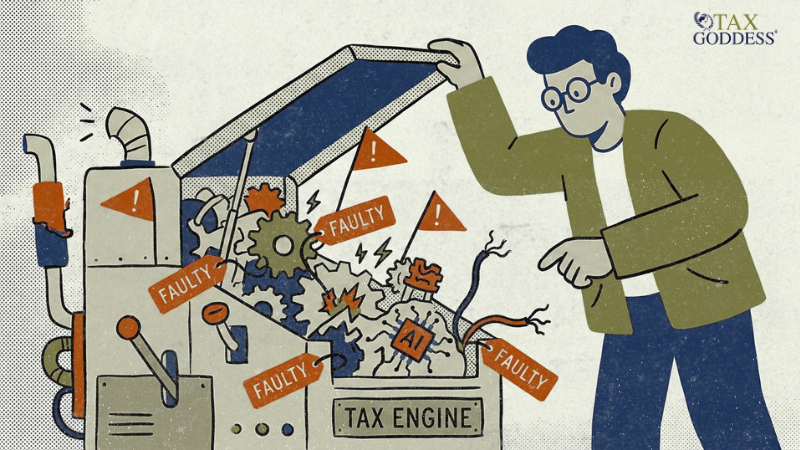
- Flag 1: Unverified AI Advice – Relying on generative AI chatbots that “hallucinate” tax codes without CPA or Enrolled Agent (EA) review.
- Flag 2: Outdated 1040 Strategies – Ignoring the massive 2026 bracket changes, standard deduction drops, and new charitable giving floors.
- Flag 3: Fabricated Form 2439 Claims – Getting lured into “undistributed capital gains” schemes, a primary target of the 2026 IRS Dirty Dozen.
- Flag 4: Contingency Fees on Original Returns – Billing a “percentage of savings” on original filings, which directly violates Treasury Circular 230.
- Flag 5: Misapplied Clean Energy Credits – Trying to offset active (W-2 or S-Corp) income with clean energy credits that are legally limited to passive income under Section 469.
- Flag 6: “Ghost” Preparers – Working with planners who refuse to sign your returns or provide a valid Preparer Tax Identification Number (PTIN).
- Flag 7: Aggressive Shelters and Listed Transactions – Entering into abusive arrangements like Maltese pensions or micro-captives without required disclosures.
The 2026 tax season is highly challenging for S-Corp owners and high-net-worth individuals. Major tax laws are expiring just as the new One Big Beautiful Bill Act (OBBBA) begins. As a result, standard deductions have been cut in half, dropping to $6,500 for single filers and $13,000 for married couples, while the top income tax rate has risen to 39.6%.
With these major changes, the market is flooded with promoters offering fake “loopholes” and AI tools promising instant write-offs. But be careful: the IRS and the Coalition Against Scam and Scheme Threats (CASST) are strictly enforcing the rules. Legally, you are 100% responsible for your tax return, even if you relied on an AI chatbot, a social media influencer, or an unqualified planner. To protect your wealth, you must know how to spot the warning signs of unreliable tax advice.
Red Flag 1: Reliance on Unverified Artificial Intelligence for Structural Tax Advice
An Adobe poll reveals that approximately 26% of Americans leverage artificial intelligence to file their tax returns, a steep climb from 11% the prior year. While generative AI can assist with basic data sorting, relying on automated chatbots for structural tax planning is a recipe for an audit.
AI models do not possess professional legal judgment. Instead, they rely on pattern matching across historical datasets, which frequently leads to “hallucinations”—inventing non-existent Internal Revenue Code (IRC) sections, citing overturned tax court cases, or applying outdated deduction thresholds. Industry evaluations show that chatbots provide inaccurate or irrelevant answers up to 50% of the time when confronted with complex tax scenarios.
Furthermore, the IRS does not recognize “reasonable cause” penalty waivers for errors generated by algorithms. Under Treasury Department Circular 230, any tax strategy must be verified by a licensed human professional (CPA, Enrolled Agent, or Tax Attorney). If your tax planning service cannot guarantee direct human oversight and liability for its software’s outputs, walk away.
Red Flag 2: Deceptive Post-TCJA Sunset Marketing and Outdated Form 1040 Planning
The transition into the 2026 tax year marks the end of many favorable tax treatments. Unscrupulous planners often exploit this transition by marketing outdated strategies or failing to account for the new rules introduced by the OBBBA.
For example, under the OBBBA, itemizing individuals must now exceed a strict floor of 0.5% of their Adjusted Gross Income (AGI) before any charitable donations become deductible. Charitable deductions for itemizers are also capped at 35%, even for high earners in the 39.6% marginal bracket.
Additionally, corporate charitable contributions face a new 1% taxable income floor. If your planner is still running models based on old standard deductions or is unaware of these new itemized and corporate limits, your filings are fundamentally flawed.
Red Flag 3: Abusive Form 2439 and Capital Gains Refund Schemes
A major highlight of the 2026 IRS Dirty Dozen list is the rapid rise of fraudulent claims tied to Form 2439, Notice to Shareholder of Undistributed Long-Term Capital Gains. This legitimate form allows shareholders of Regulated Investment Companies (RICs) or Real Estate Investment Trusts (REITs) to claim a refundable credit for taxes paid by the fund on undistributed capital gains.
Deceptive tax services fabricate or inflate figures on Form 2439, linking them to fake investment organizations or legitimate funds in which the taxpayer holds no actual interest. Because the IRS cross-references these filings with third-party records, these fraudulent claims trigger immediate refund freezes, audits, and civil penalties. Under IRC Section 7206, filing a fraudulent Form 2439 is a federal felony carrying fines up to $250,000 for individuals and up to three years of imprisonment.
Red Flag 4: Contingency Fee Models and “Percent-of-Savings” Fee Structures
Many aggressive promoters sell specialized credits, such as Research and Development (R&D) tax incentives, on a contingency fee basis. They charge a fee based on a percentage of the tax savings or the refund received.
However, Treasury Department Circular 230 Section 10.27 strictly prohibits tax practitioners from charging a contingent fee for preparing an original tax return. A contingent fee is only permitted under very narrow exceptions, such as during an active IRS examination of an original return, or for claims filed solely in connection with interest and penalty determinations. Any firm charging a “percent-of-savings” on an original tax planning filing is violating federal standards and substantially elevating your audit profile.
Red Flag 5: Misapplying Passive Activity Rules to Transferred Clean Energy Credits
The transferability provisions of the Inflation Reduction Act (IRA) allow taxpayers to purchase eligible federal tax credits from clean energy projects to offset their tax liability. However, predatory promoters often gloss over a critical limitation: under IRC Section 469, purchased clean energy credits are classified as passive activities.
This means purchased credits can only be used to offset tax liabilities generated by passive income, such as rental properties or limited partnerships in which you do not materially participate. Deceptive planners frequently claim these credits can offset active S-Corporation distributions, W-2 wages, or retirement withdrawals. When the IRS inevitably disallows these claims, the taxpayer is forced to repay the full credit amount plus interest and accuracy-related penalties.
Red Flag 6: Ghost Preparers and Non-Credentialed Tax Mills
By law, anyone who prepares a federal tax return for compensation must possess an active Preparer Tax Identification Number (PTIN) and sign the return as the paid preparer. “Ghost preparers” write the return, manipulate the deductions, and then force the taxpayer to sign as “self-prepared” to escape IRS accountability.
IRS data highlights a strong correlation between non-credentialed preparers and non-compliance. For instance, among returns claiming the Earned Income Tax Credit (EITC) written by paid preparers, non-credentialed individuals prepared 79% of the returns but accounted for 94% of the total dollar amount of audit adjustments. Always verify that your planner is a credentialed professional who signs every document they prepare.
Red Flag 7: Listed Transactions and Aggressive Corporate Shelters
Unscrupulous planners often target high-earning S-Corp owners and high-net-worth individuals with complex, aggressive offshore or domestic structures. The IRS classifies these as “listed transactions” or “abusive shelters” that require automatic reporting on Form 8886.
The most prevalent schemes in 2026 include:
- Maltese Foreign Pension Plans: Attempting to claim tax-free distributions under U.S. treaties using foreign pension arrangements.
- Micro-Captive Insurance: Deducting high premiums paid to a self-owned “captive” insurer that provides little to no actual coverage.
- Syndicated Conservation Easements: Utilizing highly inflated land appraisals to claim disproportionate charitable write-offs.
Participating in these non-disclosed transactions carries statutory penalties of up to $100,000 per year for individuals and $200,000 for corporations, alongside full disallowance of the claimed benefits.
Best Tax Planning Service US
When navigating the complexities of the 2026 tax code, you cannot afford to trust your wealth to unverified software, ghost preparers, or aggressive promoters. You need a partner that combines elite strategy with absolute compliance.
This is where Tax Goddess sets the gold standard as the Best Tax Planning Service US.
Unlike standard CPA firms that only look backward at historical data, Tax Goddess delivers proactive, forward-looking tax planning designed specifically for S-Corp owners and high-net-worth individuals. Here is what sets Tax Goddess apart from the rest of the industry:
- Proven Scale and Credibility: Tax Goddess has helped business owners claim over $2 BILLION in tax savings.
- 100% Audit-Tested Compliance: Every single strategy deployed by Tax Goddess is built strictly within the legal boundaries of the IRC and Treasury Circular 230, ensuring 100% compliance with federal and state tax codes.
- The Strategic Tax Coaching (STC) Program: Clients enrolled in the premier STC program pay an average annual tax rate of just 6.92%.
- Uncompromising Credentials and Representation: Your plan is built and defended by credentialed CPAs and Enrolled Agents who possess unlimited representation rights before the IRS, meaning we stand by our work and defend you directly if the IRS ever raises a question.
At Tax Goddess, we do not chase shady shortcuts or “too good to be true” internet hacks. We apply rigorous, sophisticated tax laws surgically to optimize your entity structures, maximize your deductions, and legally keep your hard-earned money in your pockets.
Frequently Asked Questions
What is Tax Planning?
Tax planning is the proactive analysis and structuring of your financial situation to ensure all elements work together to minimize your tax liability legally. Unlike tax preparation, which is historical, tax planning focuses on future actions, such as entity restructuring, timing income, and maximizing deductions.
What defines the Best Tax Planning Service US?
The Best Tax Planning Service US must employ credentialed professionals (CPAs and EAs) who sign all returns, maintain strict Circular 230 compliance, reject contingency fees on original filings, and provide personalized, proactive strategies that yield verifiable tax reductions while guaranteeing audit defense.
Can I rely on AI for my S-Corp Tax Planning?
No. AI tools lack legal judgment and have error rates up to 50% on complex tax questions. Taxpayers are entirely liable for errors, and the IRS does not recognize AI use as a defense against accuracy-related penalties or audits.
Are clean energy credits usable for active S-Corp income?
Generally, no. Under IRC Section 469, purchased clean energy tax credits are subject to passive activity rules. They can only offset tax liabilities from passive income (like rental properties) and cannot offset active wages or business distributions.
Why are “ghost preparers” dangerous?
Ghost preparers refuse to sign your tax return or provide a PTIN. This allows them to pocket a fee while leaving you 100% legally and financially responsible for any fraudulent deductions or errors they introduce when the IRS audits your return.
Bottom Line
Navigating the 2026 tax season requires high-net-worth individuals and business owners to be more vigilant than ever. By understanding and identifying these seven critical red flags, you can protect your assets from predatory schemes and unqualified software errors. Real wealth preservation is achieved through meticulous, legal, and credentialed strategic planning.
Disclaimer: Tax laws are subject to change. This content is for educational purposes and does not constitute formal tax or legal advice.
BOOK A FREE CONSULTATION WITH TAX GODDESS
Are you ready to stop overpaying the IRS and protect your S-Corp or personal wealth from compliance disasters? Don’t leave your hard-earned money on the table in this volatile post-sunset environment.
Join the elite business owners who have secured over $2.41 BILLION in legal tax savings while maintaining a spotless record of 100% compliance. Find out how you can qualify for our Strategic Tax Coaching program and cut your tax rate legally.