

Key Takeaways
- The Earned Income Tax Credit is a valuable, refundable federal tax credit designed for working individuals, but earning too much passive investment income will completely disqualify you.
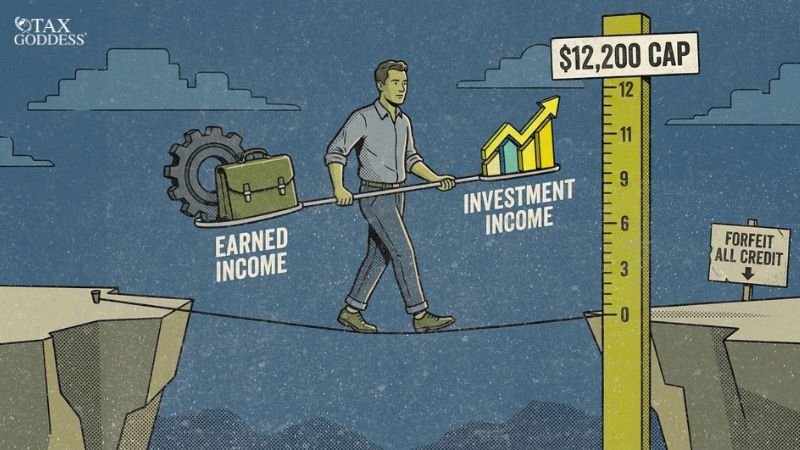
- For the 2025 tax year, the IRS investment income limit is capped at $11,950. Under updated rules for the 2026 EITC limits, this ceiling rises to $12,200.
- Investment income includes taxable interest, tax-exempt interest, corporate dividends, net capital gains, rental property profits, and royalties.
- Exceeding the investment income cap by just $1 causes a complete forfeiture of the credit, creating an abrupt tax cliff.
- Smart tax strategy, such as utilizing tax-advantaged retirement accounts, tax-loss harvesting, and proper reporting of business asset sales, can protect your eligibility while maintaining long-term wealth-building goals.
Historically, the IRS capped investment income for the Earned Income Tax Credit (EITC) at under $3,000, meaning minor interest could completely disqualify you. Recent updates have significantly raised these thresholds to $11,950 for 2025 and $12,200 for 2026, allowing taxpayers to earn more investment income without losing their credit.
Whether you are an entrepreneur structuring payroll, a high-net-worth investor helping family members navigate their filings, or someone balancing active work with growing portfolio assets, understanding how passive income interacts with federal tax credits is essential for proactive tax planning.
How the Earned Income Tax Credit Investment Cap Works
The Earned Income Tax Credit (EITC) is a refundable credit aimed at workers with low-to-moderate earnings. Because it is refundable, it can reduce your tax liability below zero, putting cash directly back into your pocket.
However, Congress built a “disqualified income” safeguard into the tax code to ensure the benefit goes strictly to households relying on active labor rather than passive capital holdings. This safeguard sets an absolute ceiling on unearned income.
If your unearned investment returns stay at or below $11,950 for 2025 (or $12,200 for 2026), you pass the investment test. But if you exceed that cap by even a single dollar, you lose 100% of the credit, regardless of your active wage amount or how many dependents you support.
What Counts as Disqualified Investment Income?
The IRS calculates your total investment income by adding up several unearned income streams:
- Interest Income: Both taxable bank interest and tax-exempt municipal bond interest.
- Dividend Income: Ordinary and qualified dividends from stocks or mutual funds.
- Capital Gains: Net capital gains realized from selling stocks, crypto, mutual funds, or real estate. Net capital losses are capped at zero for this calculation and cannot be used to reduce interest or dividend totals.
- Rental and Royalty Income: Net positive income generated from rental real estate or intellectual property after allowable expenses.
- Passive Business Income: Profits from business ventures in which you do not materially participate.
The Hidden Trap for Business Owners
If you own a business or sole proprietorship and sell commercial assets, such as work trucks, machinery, or real estate, the resulting gains might initially look like capital gains on your tax forms.
Fortunately, IRS rules provide special relief. Gains from the sale of active business property (reported on Form 4797) are backed out of the EITC investment calculation via IRS Publication 596 Worksheet 1. This ensures business owners liquidating operational equipment are not unfairly penalized for standard commercial activities.
Core Eligibility: Income, Dependents, and Age Rules
Staying under the investment threshold is only one piece of the puzzle. To qualify for the credit, you must also satisfy basic filing status, age, and earned income requirements:
- Filing status for EITC: You can claim the credit if your status is Single, Head of Household, Qualifying Surviving Spouse, or Married Filing Jointly. Taxpayers filing as Married Filing Separately are generally ineligible, unless they meet specific statutory separation criteria.
- EITC age requirements: If you claim qualifying children, there is no age restriction on you as the primary taxpayer. However, childless workers must meet specific EITC age requirements, meaning you must be between 25 and 64 years old at the end of the tax year.
- EITC limits 2026 Overview: For 2026, maximum credit amounts rise to $8,231 for taxpayers with three or more children, $7,316 for two children, $4,427 for one child, and $664 for filers without children. Overall Adjusted Gross Income (AGI) caps for joint filers with three or more children reach up to $70,244.
Smart Tax Strategy and Wealth Building
Maintaining eligibility for valuable tax credits while focusing on long-term wealth building requires intentional planning. Consider these practical tax strategies:
- Tax-Loss Harvesting: Realizing capital losses before the end of the tax year can directly offset capital gains, keeping your net capital gain figure under the IRS investment cap.
- Tax-Deferred Sheltering: Holding yield-generating investments inside tax-advantaged accounts like Traditional IRAs, Roth IRAs, or 401(k) plans prevents interest and dividends from showing up as current taxable investment income.
- Asset Placement Strategy: Placing growth-oriented or non-dividend-paying assets in taxable accounts while keeping high-yield cash vehicles in tax-sheltered accounts helps manage overall reportable unearned income.
Frequently Asked Questions
What are the EITC limits for 2026?
Under the EITC limits 2026, the investment income ceiling is $12,200. Maximum credit amounts range from $664 for childless workers up to $8,231 for families with three or more children, depending on total adjusted gross income and filing status.
What is the required filing status for EITC?
Eligible filing status for EITC rules include Single, Head of Household, Qualifying Surviving Spouse, or Married Filing Jointly. Taxpayers using Married Filing Separately generally do not qualify unless they live apart from their spouse and meet specific child residency requirements.
What are the EITC age requirements?
The EITC age requirements depend on whether you claim dependents. Parents claiming qualifying children have no age limits. Workers claiming the childless credit must be at least 25 years old but under age 65 at the end of the tax year.
How does tax planning help protect tax credit eligibility?
Proactive tax planning helps manage capital gains through loss harvesting and retirement accounts. This prevents passive income from unexpectedly exceeding IRS thresholds, preserving credit eligibility without slowing down your broader wealth-building momentum.
Bottom Line
Navigating federal tax credits while managing active business revenue and portfolio investments requires a clear understanding of IRS boundaries. By paying close attention to investment income caps, utilizing IRS adjustment worksheets for business asset sales, and structuring your accounts intelligently, you can optimize your total return and keep your tax strategy on track.
Disclaimer: Tax laws are subject to change. This content is for educational purposes and does not constitute formal tax or legal advice.
Optimize Your Tax Strategy with Tax Goddess
Looking to protect your hard-earned assets, navigate complex IRS limits, and significantly lower your tax burden?
At Tax Goddess, we specialize in advanced, fully legal tax reduction strategies tailored for business owners and high-net-worth individuals. We have saved our clients over $2.41 BILLION in taxes through customized, proactive planning.
Don’t leave your money on the table or let unexpected IRS caps catch you off guard.