

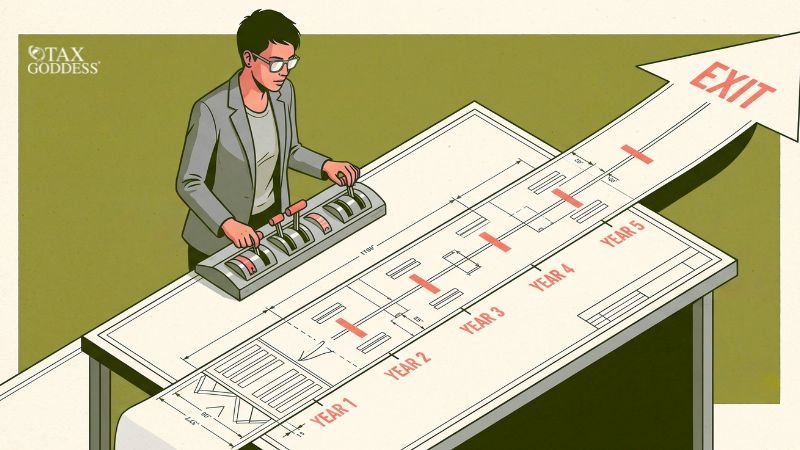
Here’s an uncomfortable truth about retirement tax planning: the five years before you walk out the door for good are often the most expensive years of your financial life. Usually, this has nothing to do with spending more. It’s often because you are earning more, and the IRS knows it.
You’ve spent decades stacking cash into 401(k)s and investment accounts, quietly building toward the finish line. But here’s the issue: accumulation and withdrawal are two completely different games, and most people don’t realize they need tax planning until it’s too late.
If you are within five years of your expected exit, this is your window. A proper retirement tax planning audit right now could mean the difference between a retirement that stretches comfortably for decades and one that gets nibbled away by taxes you didn’t see coming.
To optimize your transition, keep this high-level checklist in mind:
- Max Out Your Tax-Sheltered Super-Sizers: Take full advantage of the updated 2026 limits for 401(k)s, SIMPLE IRAs, and HSAs to dramatically lower your current taxable income.
- Prepare for the Roth Catch-Up Mandate: Understand how the SECURE 2.0 Roth catch-up rule affects your late-stage savings if you earn more than $150,000.
- Establish Your Multi-Year Roth Conversion Ladder: Map out conversions during your “retirement gap years” to secure tax-free compounding while evading structural five-year rule penalties.
- Sidestep the Senior Surtax Phaseout and Surcharges: Avoid the hidden 6% marginal surtax on the temporary above-the-line senior deduction, and dodge Medicare IRMAA cliffs and the 3.8% Net Investment Income Tax (NIIT).
- Optimize Your Portfolio Location and Concentrated Assets: Relocate highly taxed assets to tax-deferred accounts and evaluate Net Unrealized Appreciation (NUA) for concentrated company stock.
Ramping Up Your Savings and Navigating the SECURE 2.0 Roth Mandate
During your final five working years, maximizing contributions to tax-advantaged accounts is your primary defense against peak marginal tax brackets. For the 2026 tax year, the IRS has adjusted contribution limits upward, giving you more room to shield your income:
- Workplace 401(k) and 403(b) Plans: The standard contribution limit has increased to $24,500.
- Standard Catch-Up Deferrals: If you are age 50 or older, you can contribute an additional $8,000, bringing your total potential contribution to $32,500.
- “Super” Catch-Up Deferrals: If you are between the ages of 60 and 63, SECURE 2.0 allows an enhanced catch-up of $11,250, pushing your maximum workplace plan contribution to $35,750.
- SIMPLE IRAs: The base contribution limit rises to $17,000 (and up to $18,100 for certain applicable plans), with standard catch-up limits set at $4,000 and “super” catch-ups at $5,250.
However, if you are a high earner, a critical statutory change taking effect on January 1, 2026, requires immediate attention. Under the SECURE Act 2.0, if your prior-year Social Security FICA wages (reported in Box 3 of your W-2) from your current employer exceeded $150,000, all catch-up contributions must be made on an after-tax Roth basis.
This means you lose the immediate upfront ordinary tax deduction on those catch-up dollars. Furthermore, you must audit your company’s plan specifications with human resources. If your employer’s plan does not support a Roth option and your wages exceed the $150,000 threshold, you are legally barred from making any catch-up contributions at all.
Harnessing HSAs as Triply-Tax-Advantaged Vehicles
While most people view Health Savings Accounts (HSAs) as short-term medical accounts, savvy pre-retirees treat them as premier retirement accounts. HSAs offer an unmatched triple-tax advantage: contributions are tax-free, growth is completely tax-free, and distributions remain tax-free when used for qualified medical expenses.
For the 2026 tax year, the IRS limits are:
- Self-Only Coverage Limit: $4,400.
- Family Coverage Limit: $8,750.
- Catch-Up Contribution (Age 55+): An additional $1,000 per eligible spouse.
Under the OBBBA, eligibility has dramatically expanded. All Bronze and Catastrophic ACA marketplace plans now automatically qualify for HSA contributions. Additionally, Direct Primary Care (DPC) memberships are officially HSA-compatible (provided monthly fees are under $150 for individuals or $300 for families), and telehealth coverage has been made permanently pre-deductible.
The optimal tax planning strategy is to pay your current medical expenses out of pocket, save your receipts, and let your HSA grow untouched to compound tax-free. After age 65, you can withdraw funds from your HSA for non-medical expenses penalty-free, paying only ordinary income tax, effectively turning it into a traditional IRA with a tax-free health escape hatch.
Mastering the Roth Conversion and the Two Five-Year Clocks
For many pre-retirees, the “retirement gap years” (the sweet spot between your career exit and the start of RMDs at age 73 or 75, or the claiming of Social Security) represent the ultimate window for executing Roth conversions. By converting pre-tax assets to a Roth IRA, you pay taxes on the converted amount now in exchange for tax-free compounding and distributions later.
However, you must navigate two separate IRS five-year clocks to avoid tax penalties:
- The Contribution Clock (Earnings): Earnings inside a Roth IRA can only be withdrawn tax-free if the account has been open for at least five years, regardless of whether you are over age 59½. Because the first dollar contributed starts the clock for all your Roth IRAs, opening a Roth IRA with a nominal amount as early as possible is highly recommended.
- The Conversion Clock (Principal): For individuals under age 59½, each separate Roth conversion event starts its own independent five-year clock. If you withdraw converted principal before that specific five-year clock runs out, you will owe a 10% early withdrawal penalty. This penalty clock is entirely eliminated once you reach age 59½.
The OBBBA Senior Deduction and the Hidden 6% Surtax
The OBBBA introduced a temporary above-the-line deduction for seniors aged 65 or older of $6,000 per person ($12,000 for a married couple where both are 65+), running from 2025 through 2028. This is fantastic for lower-income retirees, but it phases out at a rate of 6% of modified adjusted gross income (MAGI) above $75,000 for single filers and $150,000 for married couples.
This phaseout creates a hidden marginal tax surtax for those executing Roth conversions. In the 22% joint bracket, as your MAGI rises from $150,000 to $350,000, the 6% deduction clawback adds an effective 1.3 percentage points to your marginal tax rate, pushing your true marginal rate to 23.3%. Within the 24% bracket, the effective rate climbs to 25.4%. Once your income crosses $350,000, the deduction is fully phased out, and your rate drops back to the statutory level. High-precision planning is required to avoid converting yourself directly into this hidden tax bracket spike.
Managing High-Income Surcharges: Medicare IRMAA and the NIIT
Failing to manage your MAGI five years before your expected exit can trigger two significant tax penalties:
The Medicare IRMAA Surcharge Cliff
Your Medicare Part B and Part D premiums are determined by your MAGI from two years prior. For the 2026 premium year, the IRS looks directly at your 2024 tax return. Under the 2026 guidelines, surcharges begin at a MAGI of $109,000 for single filers and $218,000 for married couples filing jointly.
Because IRMAA operates on a strict cliff system, earning just one dollar over a threshold triggers the full surcharge for that entire bracket, potentially costing you thousands of dollars in extra annual premiums.
If you experience a sharp decline in income due to retirement, you can submit Form SSA-44 to request a premium recalculation based on a more recent year. The SSA recognizes eight specific life-changing events, including:
- Work stoppage (retirement)
- Work reduction
- Divorce or annulment
- Death of a spouse
- Loss of income-producing property (from uncontrollable disasters or fraud)
- Loss or reduction of pension income
- Employer settlement payouts
The Net Investment Income Tax (NIIT) Surtax
The NIIT imposes an additional 3.8% surtax on the lesser of your net investment income or the amount your MAGI exceeds statutory thresholds:
- $250,000 for married couples filing jointly
- $200,000 for single filers
While Roth conversions and retirement plan distributions are not themselves subject to the 3.8% NIIT, they are included in your MAGI. Consequently, a large Roth conversion or RMD can push you over the threshold, indirectly exposing your regular taxable investments, capital gains, and dividends to the 3.8% surtax.
Sophisticated Asset Location and Net Unrealized Appreciation (NUA)
Optimizing where your investments are held can add up to 30 basis points of annualized after-tax return to your portfolio without requiring you to take on additional market risk:
- High-Growth Equities: Place these inside tax-exempt Roth accounts to ensure years of compounding growth can be withdrawn entirely tax-free.
- High-Yield Fixed Income and REITs: Keep these in tax-deferred traditional accounts to shield their heavily taxed ordinary dividend and interest payments from current-year tax drag.
- Broad Index Funds and Municipal Bonds: Keep these in your taxable brokerage accounts, enjoying preferential long-term capital gains tax rates on the index funds and federally tax-free interest on the muni bonds.
The NUA Exit Strategy for Appreciated Company Stock
If you are a corporate executive or business owner holding highly appreciated company stock inside an employer-sponsored 401(k), the Net Unrealized Appreciation (NUA) rule offers a unique, one-time tax-reduction opportunity.
To execute this tax strategy, you must meet three strict IRS mandates:
- Triggering Event: The distribution must follow a qualified event, such as separation from service, turning age 59½, disability, or death.
- Lump-Sum Distribution: You must distribute your entire 401(k) balance (not just the stock portion) within a single calendar year.
- In-Kind Transfer: The company stock must be transferred as actual shares (in-kind) directly into a taxable brokerage account. Any non-stock assets in your 401(k) can be rolled over to a Traditional IRA to preserve tax deferral.
By executing this transfer, you pay ordinary income tax only on the original cost basis of the company stock in the year of distribution. The accumulated appreciation (the NUA portion) is not taxed immediately; instead, when you eventually sell the stock, it is taxed at favorable long-term capital gains rates (capped at 20%), saving you significant tax dollars. Note that the NUA portion of the stock does not receive a step-up in basis at your death, which is a key tradeoff to evaluate with your tax advisor.
4. Frequently Asked Questions
Is retirement income taxable?
Yes, most retirement income is taxable. Traditional 401(k) and IRA withdrawals are taxed as ordinary income, while pensions and a portion of Social Security also face taxes. Conversely, qualified Roth and HSA withdrawals are entirely tax-free, playing a vital role in your wealth preservation.
How do I appeal my Medicare IRMAA premiums?
To appeal, file Form SSA-44 with the Social Security Administration after receiving your assessment. You must prove a qualifying life-changing event—like retirement, work reduction, or divorce – and provide tax returns and supporting evidence to adjust your Medicare premiums.
What is the five-year rule for Roth conversions?
This rule requires converted funds to remain in your Roth IRA for five tax years to avoid a 10% early withdrawal penalty if you are under age 59½. Each conversion starts its own separate five-year penalty clock on January 1 of the conversion year.
Why do HNWIs need a proactive tax strategy?
A proactive tax strategy is essential for wealth building and smart tax planning before retirement. By strategically structuring distributions and timing conversions, you secure long-term wealth preservation, insulate your portfolio from future tax hikes, and prevent unnecessary Medicare surcharges.
Bottom Line
Transitioning from wealth accumulation to strategic decumulation is a multi-year process. The choices you make in the five years prior to retirement—from optimizing your accounts and managing tax brackets to timing your conversions and coordinates—will directly determine the longevity of your portfolio. Do not wait until you receive your final paycheck to build your pre-retirement audit. Partnering with qualified professionals ensures your hard-earned wealth is insulated from unnecessary tax drag.
Disclaimer: Tax laws are subject to change. This content is for educational purposes and does not constitute formal tax or legal advice. Always consult with a qualified tax professional regarding your specific situation before implementing any strategies.
6. Get Your Personalized Plan with Tax Goddess
Are you ready to take complete control of your pre-retirement tax audit? At Tax Goddess, we specialize in helping business owners, high-net-worth individuals, and pre-retirees identify hidden savings and structural inefficiencies in their finances. We have successfully secured over $2.35 BILLION in tax savings for our clients.
Do not leave your retirement security to chance or standard rules of thumb.
BOOK A FREE CONSULTATION with the Tax Goddess team today to build a customized pre-retirement tax strategy tailored to your exact lifestyle and wealth-building goals.