
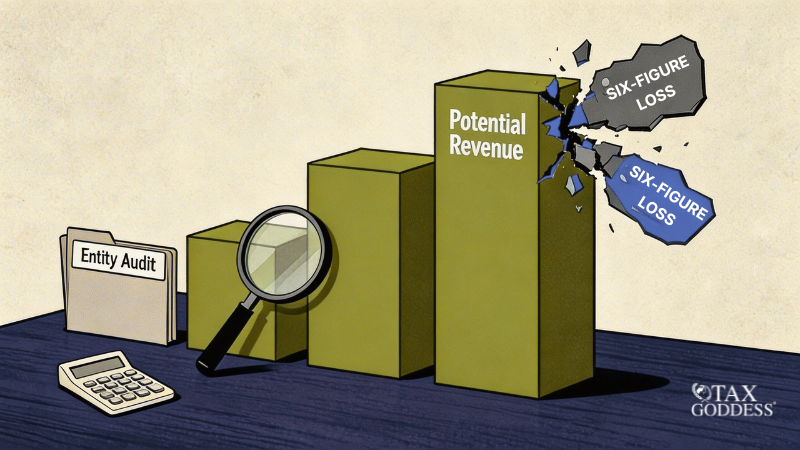
For business owners generating $1 million or more in annual profit, the choice between an S-Corporation and a C-Corporation is one of the most significant financial decisions you will make. In 2026, choosing the wrong entity structure can easily cost you over $100,000 in unnecessary taxes.
The tax landscape changed fundamentally on July 4, 2025, with the signing of the One Big Beautiful Bill Act (OBBBA). This law made many temporary tax cuts permanent and introduced new rules specifically for high-income earners. If you haven’t reviewed your entity structure since this law passed, you may have a massive “tax leak” in your business.
Key Takeaways for High Earners in 2026
- Permanent Tax Savings: The 20% Qualified Business Income (QBI) deduction is now permanent, effectively dropping the top federal tax rate to 29.6% for many S-Corporation owners.
- The S-Corporation Advantage: At the $1 million profit level, an S-Corporation typically saves an owner approximately $105,000 per year in federal taxes compared to a C-Corp if all profits are distributed.
- C-Corporation for Big Exits: The C-Corp remains the only way to access the Qualified Small Business Stock (QSBS) exclusion, which now allows for up to $15 million in tax-free gains upon a sale.
- SALT Cap Workarounds: While the personal SALT deduction cap has risen to $40,400, it is phased out for those earning $1 million, making Pass-Through Entity Tax (PTET) elections essential for high earners.
- Hybrid Models: High earners who do not need all their cash flow for personal use can use a split-entity strategy to defer taxes at the lower 21% corporate rate.
How the 2026 OBBBA Tax Laws Impact High-Earning Business Owners
In 2026, the federal government uses a system of seven tax brackets for individuals, ranging from 10% to a top rate of 37%. For a married couple filing a joint return, that top 37% rate applies to every dollar earned over $768,700.
C-Corporations, however, pay a flat tax rate of 21% on all profits regardless of how much they make. While a 21% rate sounds much better than 37%, the “Double Taxation” of a C-Corp often makes it more expensive for owners who need to take money out for personal use. Double taxation means the business pays tax on the profit first, and then you pay tax again when you receive that money as a dividend or payment.
S-Corp Tax Benefits for $1 Million Profit: Maximizing the 20% QBI Deduction
An S-Corporation is a “pass-through” entity. This means the business itself does not pay federal income tax. Instead, the $1 million in profit “passes through” the business and is reported on your personal tax return.
The biggest advantage for S-Corporations in 2026 is the Qualified Business Income (QBI) deduction, which the OBBBA made permanent. This rule allows many business owners to deduct 20% of their business income before they even calculate their taxes.
For a business with $1 million in profit, this deduction can effectively drop your top federal tax rate from 37% down to 29.6%. However, there is a catch. If your business is a Specified Service Trade or Business (SSTB) – which includes fields like law, medicine, accounting, or consulting – this deduction is completely phased out once your total income exceeds $275,000 for single filers or $550,000 for married couples. If you are a high-earning professional in one of these fields, the S-Corp’s main benefit is no longer the QBI deduction, but rather the savings on payroll taxes.
Why the IRS Cares About Your “Reasonable Salary” at the $1M Profit Level
One of the most powerful features of an S-Corporation is the ability to split your income into two parts: a Reasonable Salary and a Distribution.
A “Reasonable Salary” is the amount of money you would have to pay an outside person to do your exact job. You must pay FICA taxes (Social Security and Medicare) on this salary. However, the rest of the profit you take out as a “distribution” is not subject to these payroll taxes.
For an established business making $1 million in profit, the IRS expects a defensible salary, usually ranging between $90,000 and $200,000, depending on your industry. By taking only a portion of your income as a salary and the rest as a distribution, you can save roughly 15.3% in taxes on every dollar that avoids the Social Security wage limit, which is $184,500 for 2026.
How the $15 Million QSBS Rule Makes C-Corps a Power Move for Tech Founders
A C-Corporation is usually the best choice if you plan to sell your company for a massive profit in the future. This is due to a rule called Section 1202, also called Qualified Small Business Stock (QSBS).
Under the new OBBBA rules, if you hold stock in a qualified C-Corporation for at least five years, you can potentially exclude up to $15 million of your profit from the sale from any federal tax. The law even added “tiered” benefits: if you sell after only three years, you can exclude 50% of your gain, and after four years, you can exclude 75%. This benefit is not available to S-Corps or LLCs, making the C-Corp the gold standard for high-growth startups targeting an acquisition.
Avoiding the “Double Taxation” Trap: Why C-Corps Can Cost You $100,000 or More Annually
If you are a business owner who needs to take out the full $1 million in profit to fund your lifestyle, a C-Corporation is almost always a mistake. Here is the breakdown of the “Double Taxation” cost:
First, the C-Corp pays a 21% flat tax on the $1 million, which is $210,000. This leaves $790,000 in the bank. When you take that remaining money out as a dividend, you pay a second tax (the dividend tax) of roughly $197,000. Your total federal tax bill would be approximately $407,000.
In contrast, an optimized S-Corporation owner earning the same $1 million would likely pay about $302,000 in total federal taxes, including income tax and payroll tax. By staying in an S-Corporation, you keep an extra $105,000 in your pocket every year. You could
Beating the SALT Cap Phase-Out with the Pass-Through Entity Tax (PTET)
If you live in a high-tax state like California, New York, or New Jersey, you have likely heard of the SALT cap. This is a limit on how much State and Local Tax (SALT) you can subtract from your federal tax return.
For 2026, the OBBBA raised this cap to $40,400. However, high earners face a “phase-out.” For every dollar your income exceeds $505,000, your SALT deduction is reduced by 30 cents. For someone earning $1 million, this reduces your allowed deduction back down to the minimum of $10,000.
To beat this, 36 states allow you to use a Pass-Through Entity Tax (PTET). This allows your S-Corporation to pay the state tax directly at the business level. Because the business pays it, the IRS treats it as a business expense, which is 100% deductible on your federal return. This strategy effectively lets you bypass the $10,000 limit and save tens of thousands in federal taxes.
Is a Hybrid S-Corp and C-Corp Structure the Ultimate Tax Strategy for High Earners?
Some sophisticated business owners use a Hybrid Strategy where they own both an S-Corporation and a C-Corporation. For example, you might earn $500,000 in your S-Corporation for your personal living expenses and earn another $500,000 in a separate C-Corp that holds your trademarks or brands.
The advantage is that the $500,000 in the C-Corp is only taxed at 21%, and you can leave that money inside the company to reinvest in growth or new equipment. If you don’t need the cash for 5 to 15 years, you can defer the second layer of dividend tax for a long time, allowing that “saved” tax money to grow and compound inside the business.
Bottom Line: The Best Choice for You
For the majority of business owners who need their profits for personal expenses, the S-Corporation is the superior choice for 2026. It offers the best mix of payroll tax savings, the 20% QBI deduction, and the ability to use PTET to lower your state tax burden.
However, if your goal is to reinvest every penny into the business to prepare for a multi-million dollar sale, the C-Corporation and its $15 million tax-free exit is a benefit that is impossible to ignore.
Unlock the Lowest Tax Rate You’ve Ever Paid With Tax Goddess
Choosing the right entity is just the start. In 2026, you need a proactive strategy to stop “tax leaks” from draining your profit.
Through Strategic Tax Coaching (STC), we build advanced tax shields that deliver real results. Our STC clients pay an average annual tax rate of just 6.92%.
With over $2.05 Billion saved for our clients, we know exactly how to navigate the tax code to protect your wealth. Whether you’re a real estate investor or a tech founder, we ensure you pay the absolute legal minimum.
Don’t settle for basic accounting. Join the BILLION-DOLLAR TAX CLUB.