The Overview
- The Big Debut: Starting with 2025 transactions, brokers must issue Form 1099-DA to report digital asset sales and exchanges.
- The “Basis” Gap: Most forms arriving in early 2026 will show your proceeds but not your cost basis. If you don’t reconcile this, the IRS might assume your entire sale is taxable gain.
- Strategic Giving: The OBBBA (One Big Beautiful Bill Act) introduces a 0.5% AGI “floor” for charitable deductions in 2026, making “bunching” strategies essential for digital asset donors.
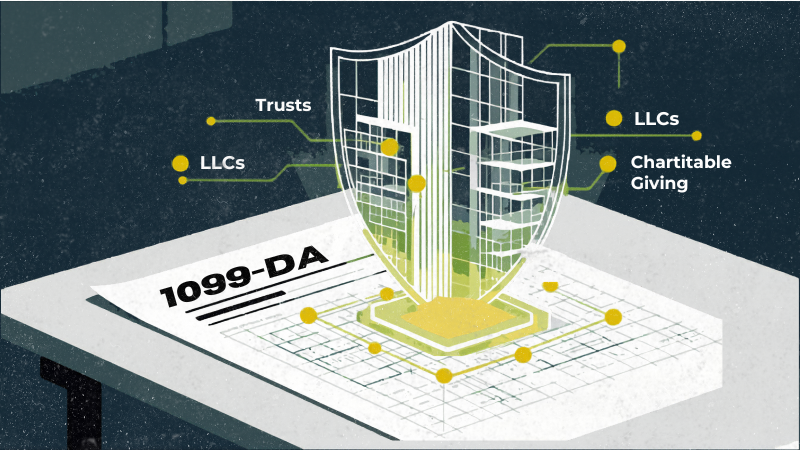
- Asset Protection: Moving assets into a Grantor Trust or LLC can offer privacy and smoother estate transitions, especially with new state rules like the New York LLC Transparency Act.
For years, digital assets have been the financial version of a teenager’s bedroom: everybody knows something is going on in there, but nobody really wants to open the door. Well, the IRS just walked in, turned on the lights, and handed you a piece of paper called Form 1099-DA.
Thanks to the Infrastructure Investment and Jobs Act (IIJA), centralized exchanges and hosted wallets are now “brokers” required to report your activity directly to the government.
For many, receiving a Form 1099-DA feels like the digital equivalent of a “check engine” light. But smart taxpayers see it as a prompt to move from reactive filing to proactive tax planning. Whether you’re navigating missing cost basis or looking for wealth-building structures, this form is actually your invitation to a much bigger conversation about your financial future.
The Deep Dive: Maximizing Form 1099-DA for Your Tax Strategy
Why Your Form 1099-DA May Have Missing Cost Basis Information
The 2025 tax year is a transition period. While brokers must report “gross proceeds” (what you sold the asset for), reporting “cost basis” (what you paid) is voluntary for 2025 transactions.
This creates the “Year of the Gap.” If you bought Bitcoin on one exchange, moved it to a hardware wallet, and then sold it on a different exchange in 2025, that second broker has no idea what you originally paid.
- The Risk: A blank basis field on your 1099-DA is essentially the IRS saying, “Prove you paid anything for this, or we’ll tax the whole amount”.
- The Solution: You must manually reconcile your history on Form 8949 using new digital asset categories (Boxes G through L).
Advanced Tax Planning: Gifting Crypto and Navigating the OBBB Act Floor
Donating appreciated crypto remains a powerhouse tax strategy. If you’ve held an asset for over a year, you can deduct the full fair market value and avoid capital gains tax entirely. However, the OBBB Act of 2025 added some hurdles for 2026:
- The 0.5% AGI Floor: You can only deduct the portion of your charitable gifts that exceeds 0.5% of your Adjusted Gross Income.
- The Math: If your AGI is $1,000,000, the first $5,000 of your donations are effectively non-deductible: Deduction = Total Gifts – (0.005 x AGI)
- Strategy: “Bunch” your donations. Instead of giving $5,000 every year, give $15,000 every three years to clear the floor and maximize your deduction.
Wealth Building Structures: Using LLCs and Trusts for Digital Assets
As your digital portfolio grows, the “how” you hold it becomes as important as “what” you hold.
- Grantor Trusts: These are excellent for wealth building because they allow you to pay the trust’s income tax personally, effectively making a “tax-free gift” to your heirs. The IRS also recently provided a safe harbor for investment trusts to “stake” assets without losing their simple tax status.
- LLC Transparency: While the federal Corporate Transparency Act (CTA) was narrowed in 2025 to exclude most domestic U.S. companies, states are filling the gap. The New York LLC Transparency Act (NYLTA) takes effect January 1, 2026, requiring LLCs to report beneficial owners.
Digital Asset Estate Planning: Protecting Private Keys and Inheritance
With the federal estate tax exemption rising to $15 million per person in 2026, many HNWIs may think they are “safe” from estate taxes. But digital assets have a unique “delete” button: losing the private keys.
- RUFADAA Compliance: Ensure your will or trust specifically references the Revised Uniform Fiduciary Access to Digital Assets Act (RUFADAA) to give your heirs legal permission to access your accounts.
- Technical Access: A “dead man’s switch” or a multi-signature wallet is essential to ensure that if you disappear, your private keys don’t disappear with you.
Frequently Asked Questions
What does the 1099-DA mean for my tax return?
It means the IRS has a record of your digital asset proceeds. You must reconcile these amounts on Form 8949 and Schedule D to ensure you only pay tax on your actual gains, not the total sale price.
Why did I get a 1099-DA with missing info?
For 2025, brokers are not required to report your cost basis. If you transferred assets into an exchange from an outside wallet, the broker lacks the data to calculate your original purchase price.
Can a 1099-DA help me lower my taxes?
Directly? No. But it acts as a roadmap for tax planning. It forces a reconciliation that often reveals “lost” basis or opportunities for loss harvesting that you might have otherwise missed.
How do I gift crypto to charity for a tax break?
Donate appreciated assets held for >1 year directly to a 501(c)(3). You’ll get a full value deduction and avoid capital gains tax. Note: Donations over $5,000 require a qualified appraisal.
Should I hold crypto in an LLC or a Trust?
LLCs offer liability protection but face increasing state-level transparency rules. Irrevocable trusts often provide superior wealth building by removing assets from your estate and offering a “basis step-up” at death.
How do digital assets affect estate planning?
If your estate plan doesn’t bridge the gap between legal title and technical access (private keys), your assets could be lost forever. Legal authorization via RUFADAA is the first step.
Bottom Line
In March 2026, the Treasury and IRS issued new proposed regulations to streamline the electronic delivery of Form 1099-DA. This is a clear signal that the IRS is moving away from “science experiments” and into a mature, scalable reporting environment. This isn’t just a compliance hurdle for today; it’s the new normal for digital wealth.
Whether you received your form by the February 17 deadline or are still staring at a blank basis field, remember: the IRS hasn’t forgotten about that “Digital Asset” checkbox on your Form 1040. If you thought your crypto lived in a tax-free fairyland, the 1099-DA is the IRS’s way of inviting it onto your tax return. In 2026, the government expects adult supervision of your digital portfolio. Don’t wait for an audit to provide it.
Disclaimer: Tax laws are subject to change. This content is for educational purposes and does not constitute formal tax or legal advice. Always consult with a qualified tax professional regarding your specific situation before implementing any strategies.
IS YOUR TAX STRATEGY READY FOR THE 2026 SHIFT?
At Tax Goddess, we help business owners and investors design audit-proof strategies for tax reduction and wealth building.
We have helped our clients save over $2.05 BILLION in taxes by staying ahead of IRS trends like digital asset reporting and the OBBB Act.
Don’t let a “missing basis” 1099-DA turn into a massive IRS bill.
Book a FREE CONSULTATION today and let’s help convert the tax code into a competitive advantage!