
Keypoints
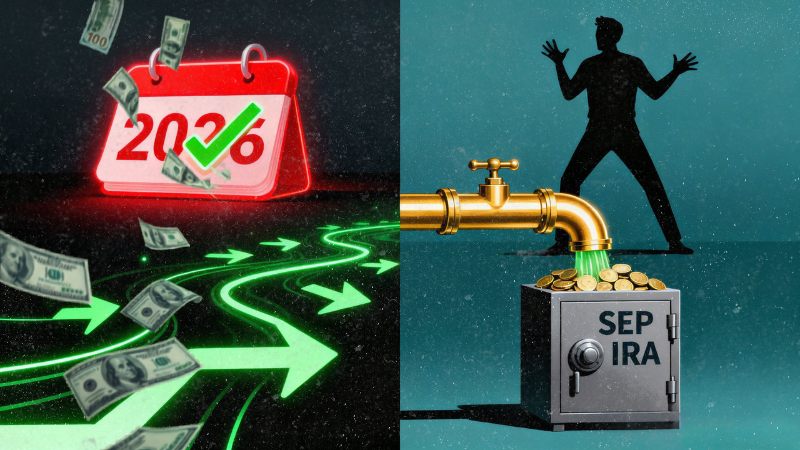
Filing a tax extension (IRS Form 4868 or 7004) is a tax planning strategy that moves your filing deadline by six months. For the self-employed, its primary value is not just “more time for paperwork,” but a legal window to fund retirement plans retroactively.
- Funding Windows: Valid extensions move the funding deadline for SEP IRAs and Solo 401(k)s to October 15, 2026, for sole proprietors and September 15, 2026, for S-Corps and Partnerships.
- Strategic Limitations: While business plans can be funded late, personal Traditional and Roth IRA contributions cannot be extended past the April 15 deadline.
- New 2026 Opportunities: Learn how to leverage the SECURE 2.0 “Super Catch-Up” for ages 60-63, allowing for total contributions up to $83,250.
- Compliance Roadmap: Key steps to claiming the $1,500 auto-enrollment tax credit via Form 8881 and avoiding the $250/day Form 5500-EZ penalty.
The April 15 deadline often causes “liquidity anxiety” for business owners. If your business was more profitable than expected in 2025, you might face a large tax bill without enough immediate cash to fund a retirement deduction.
Establishing a tax extension via IRS Form 4868 is the solution. It serves as a strategic pause, giving you the time needed to finalize your 2025 accounting with precision.
This is especially important now that the SECURE 2.0 Act is fully integrated. Using an extension ensures you aren’t guessing at your numbers when applying new benefits like:
- The $1,500 auto-enrollment tax credit
- The “Super Catch-Up” contributions: By moving your deadline, you gain the clarity needed to maximize both employee and employer contribution lanes. This strategy can potentially reduce your taxable income by five or even six figures.
How to File a Tax Extension: Form 4868 vs. Form 7004
The first step is identifying the correct tax extension form. Your business entity dictates your deadline:
- Sole Proprietors and Single-Member LLCs: You use IRS Form 4868. Your initial deadline is April 15, 2026, and your extended deadline is October 15, 2026.
- S-Corporations and Partnerships: You must file Form 7004. Since March 15 falls on a Sunday in 2026, your deadline shifts to Monday, March 16, 2026. Your extended deadline is September 15, 2026.
CRITICAL RULE: An extension to file an extension is not an extension to pay. You must estimate and pay at least 90% of your tax liability by the original deadline to avoid the 0.5% per month late-payment penalty.
The SEP IRA: The Ultimate Late-Season Tool
The SEP IRA is the “king of flexibility” because the IRS allows you to both establish and fund the plan as late as your extended tax deadline.
- The Funding Math: For self-employed individuals, the contribution limit is effectively 20% of net self-employment income (calculated as net profit minus half of self-employment tax) .
- 2025/2026 Limits: For the 2025 tax year (funded in 2026), the cap is $70,000. For 2026 income, it increases to $72,000.
- Strategic Hook: Unlike a Solo 401(k), a SEP IRA does not require you to have signed documents by December 31. You can realize you owe too much in June 2026, open a SEP, and take the deduction for 2025.
Solo 401(k) and the SECURE 2.0 “Retroactive Setup”
Historically, Solo 401(k)s had to be established by December 31. However, under SECURE 2.0 (Section 317), sole proprietors with no employees can now adopt a Solo 401(k) as late as the April 15 filing deadline and still make employee deferrals for the prior year.
- Employee Lane: For 2025, you can defer $23,500. For 2026, this increases to $24,500.
- Employer Lane: Your business can contribute an additional 25% of W-2 wages (or 20% of net profit).
- The Extension Loophole: While the plan must be adopted by April 15, filing a tax extension form 4868 allows you to delay the actual cash deposit for both portions until October 15, 2026.
The 2026 “Super Catch-Up” for Ages 60-63
For the first time in 2026, business owners in their early 60s have a unique “Super Catch-Up” opportunity.
- Standard Catch-Up (Age 50+): $8,000 in 2026.
- Super Catch-Up (Age 60-63): $11,250. This allows a 62-year-old owner to put away a staggering $83,250 ($72,000 base + $11,250 catch-up) for the 2026 tax year.
Compliance Alert: The Form 5500-EZ and Roth Mandates
- The $250,000 Asset Threshold: Once your Solo 401(k) assets (including loans) exceed $250,000, you must file Form 5500-EZ by July 31. The penalty for missing this is $250/day, capped at $150,000 per year.
- High-Earner Roth Catch-Up: Starting January 1, 2026, if your 2025 wages exceeded $150,000, your catch-up contributions must be made on a Roth (after-tax) basis.
Frequently Asked Questions
Does a tax extension extend the IRA contribution deadline?
No. While a tax extension form 4868 extends the deadline for SEP IRAs and Solo 401(k)s, it does not apply to personal Traditional or Roth IRAs. Those must be funded by April 15, 2026.
Can I contribute to a SEP IRA after April 15?
Yes. If you file a tax extension, you have until October 15, 2026 (for sole props) or September 15, 2026 (for S-Corps) to fund your SEP IRA and claim the deduction for the 2025 tax year.
How does an extension help with tax planning?
It provides the time needed to finalize complex data like K-1s and net profit calculations. This ensures you contribute the exact maximum amount to your retirement plan, avoiding 6% excise taxes on over-contributions.
How to file a tax extension online?
Individuals can file a tax extension via IRS Free File or by making an extension payment through IRS Direct Pay. Businesses can e-file Form 7004 through authorized tax software or their CPA.
Bottom Line
The “Tax Extension Loophole” is more than a deadline shift; it is a liquidity management tool. By utilizing Form 4868 or 7004, you gain 180 days of additional cash flow and the precision to maximize every available deduction under the new SECURE 2.0 framework.
Disclaimer: Tax laws are subject to change. This content is for educational purposes and does not constitute formal tax or legal advice. Always consult with a qualified tax professional regarding your specific situation before implementing any strategies.
BOOK YOUR FREE CONSULTATION WITH TAX GODDESS
Is your current CPA using every loophole in the tax code to help you avoid taxes legally? At Tax Goddess, we comb through the tax code to help business owners like you avoid unfair tax rates. We have helped our clients save over $2.05 BILLION in taxes through proactive planning and proprietary tax strategies.
Whether you are looking to maximize a Solo 401(k) Super Catch-Up or claim the auto-enrollment credit, our team is ready to help.