
The Overview
- Retirement Tax Planning Integration: As you transition out of your business, taking advantage of opportunities like the car loan interest deduction for maximum tax savings is essential. The newly enacted car loan deduction under the One Big Beautiful Bill Act (OBBBA) is a key tool in this transition.
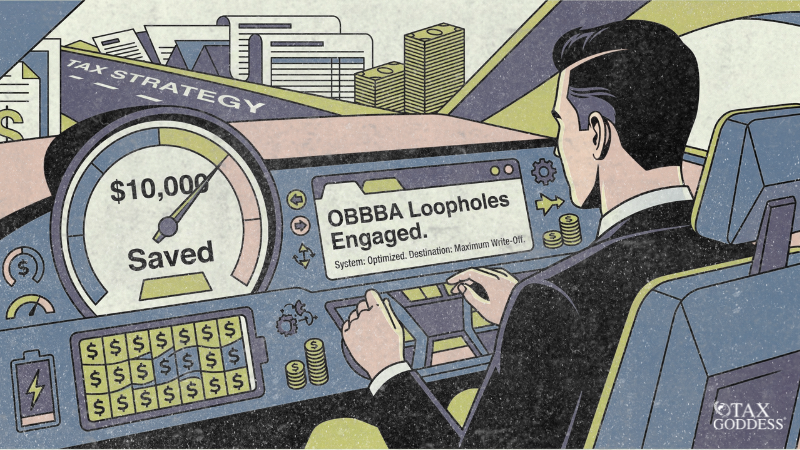
- The $10,000 Loophole: For the 2025 through 2028 tax years, eligible taxpayers can deduct up to $10,000 annually in interest paid on a qualified car loan.
- No Itemization Required: This is a “below-the-line” deduction claimed on the new IRS Schedule 1-A, meaning you can pocket these savings even if you claim the standard deduction.
- Strict Eligibility Standards: To qualify, the vehicle must be brand-new, assembled in the United States, weigh under 14,000 pounds, and be used primarily for personal travel.
- Income Limits Apply: The tax break begins to phase out if your Modified Adjusted Gross Income (MAGI) exceeds $100,000 (single) or $200,000 (married filing jointly).
You are cruising into your golden years behind the wheel of a brand-new, U.S.-assembled luxury SUV, the wind in your hair and not a care in the world until you remember that Uncle Sam is riding shotgun, eagerly waiting to tax your hard-earned wealth. For nearly 40 years, personal car loan interest was completely non-deductible under federal tax law. But the One Big Beautiful Bill Act (OBBBA) has completely shifted the tax landscape. Uncle Sam is suddenly helping you finance your next ride. For business owners and high-net-worth individuals eyeing the exit, this temporary car loan interest deduction is a powerful vehicle for smart retirement tax planning. Let’s look at how you can keep up to $10,000 of your hard-earned interest in your pocket this year.
Unlocking the OBBBA Car Loan Loophole
Under the temporary rules of the OBBBA, you can deduct $10,000 in interest paid on a “Specified Passenger Vehicle Loan” each year from 2025 through 2028. Because auto loans are frontloaded (meaning you pay the most interest in the first year of the loan), buying a qualified vehicle right now maximizes your immediate tax relief.
However, before you run to the dealership, you must make sure both your new vehicle and your loan meet these strict IRS standards:
- The Vehicle Must Be Brand-New: Used vehicles, certified pre-owned cars, and vehicles purchased at the end of a lease do not qualify. You must be the original owner.
- Final Assembly in the United States: To support domestic manufacturing, the IRS requires the car to be built in a U.S. plant. You can easily verify this by plugging your Vehicle Identification Number (VIN) into the online NHTSA VIN Decoder. Vehicles with a VIN starting with 1, 4, or 5 generally qualify.
- Weight Restrictions: The vehicle’s Gross Vehicle Weight Rating (GVWR) must be under 14,000 pounds. This covers almost all passenger cars, SUVs, minivans, and standard pickup trucks.
- First-Lien Requirement: The loan must be secured by the vehicle itself. Unsecured personal loans used to buy a car will not qualify.
The 2026 IRS Income Limits and Schedule 1-A
To claim this write-off, you will file the brand-new Schedule 1-A (Additional Deductions) along with your Form 1040. The beauty of Schedule 1-A is that it is a hybrid “below-the-line” deduction. You can claim it, and it won’t matter whether you itemize or take the standard deduction. For tax year 2026 tax, single filers can claim $16,100, and married couples filing jointly can claim $32,200. Schedule 1-A allows you to claim your car loan interest on top of these historically high standard deductions.
However, the IRS caps this benefit for high earners. The deduction starts phasing out once your Modified Adjusted Gross Income (MAGI) crosses :
- $100,000 for single filers.
- $200,000 for married couples filing jointly.
The deduction limit is reduced by $200 for every $1,000 your income exceeds these limits, phasing out entirely once your MAGI reaches $150,000 (single) or $250,000 (joint).
Personal vs. Business Use: Maximizing Your Write-Offs
If you are a business owner, you are likely used to deducting vehicle expenses on your Schedule C. To qualify for the personal OBBBA car loan interest deduction, you must meet the “more-than-50%-personal-use test” at the time you sign the loan. This means you must expect to drive the vehicle for personal or family reasons more than 50% of the time.
If you use the vehicle for both personal trips and self-employed business travel, you can optimize your tax planning to legally beat the MAGI phaseouts:
- The Standard Mileage Option: For the 2026 tax year, the business standard mileage rate is 72.5 cents per mile. If you use this standard rate on Schedule C, you can still separately deduct the business-proportionate share of your auto loan interest as a business expense.
- The Split Strategy: If you drive 40% for business and 60% for personal use, you can deduct 40% of your interest on Schedule C (which reduces your business income and is unaffected by the personal MAGI limits). You can then claim the remaining 60% of your interest on Schedule 1-A as a personal deduction, up to your adjusted personal limit.
By strategically splitting your auto interest, you can bypass personal income limitations, maximize your write-offs, and lower your overall taxable income.
Frequently Asked Questions
Is car loan interest tax deductible under the OBBBA?
Yes. Thanks to the OBBBA, you can deduct up to $10,000 in car loan interest annually through the 2028 tax year. However, the deduction only applies to qualified, brand-new personal vehicles assembled in the United States.
Do I need a Form 1098-VLI to claim this tax break?
Starting in the 2026 tax year, lenders must issue Form 1098-VLI if you paid $600 or more in interest. While this form is sent to the IRS, your ability to claim the deduction does not depend on receiving it, provided you keep accurate interest statements.
How do the standard mileage rate and car loan interest interact under OBBBA?
If you are self-employed and use the 2026 standard mileage rate of 72.5 cents per mile, you can still separately deduct the business-use portion of your interest on Schedule C. The remaining personal-use portion is claimed on Schedule 1-A.
What are the main audit risks when deducting vehicle interest?
The IRS heavily scrutinizes vehicle write-offs. The biggest audit triggers include claiming 100% business use of a personal vehicle, failing to report your vehicle’s VIN on Schedule 1-A, or accidentally double-deducting the same interest on both Schedule C and Schedule 1-A.
Bottom Line
Transitioning into retirement requires a careful look at every tax planning opportunity available. The OBBBA car loan interest deduction is a temporary, highly lucrative “loophole” that can save you thousands on a new vehicle purchase before it expires at the end of 2028. By understanding the interaction between personal deductions on Schedule 1-A and business write-offs on Schedule C, business owners can significantly lower their tax liability during their peak transition years.
Disclaimer: Tax laws are subject to change. This content is for educational purposes and does not constitute formal tax or legal advice. Always consult with a qualified tax professional regarding your specific situation before implementing any strategies.
Free Strategy Session with Tax Goddess
Why leave your retirement tax planning to chance? At Tax Goddess, we help business owners, entrepreneurs, and high-net-worth individuals build aggressive, customized, and LEGAL tax strategies that protect their wealth.
We have successfully helped our clients save over $2.3 BILLION in taxes. Whether you want to maximize the OBBBA car loan loophole, optimize your business entity structure, or prepare your business for a tax-efficient exit, we can help you keep more money in your pocket legally.