
Keypoints
- States With No Property Tax: While every state levies property tax, Hawaii (0.27%) and Alabama (0.38%) offer the nation’s lowest effective real estate rates in 2026.
- BPP Exemption Breakthroughs: Businesses are prioritizing states with massive Business Personal Property (BPP) exemptions, such as Indiana’s $2 million threshold and Texas’s $125,000 per-location exemption.
- Relocation Deductibility: Under the One Big Beautiful Bill Act (OBBBA), civilian relocation expenses are non-deductible; all employer-paid moving costs must be reported as taxable wages on Form W-2.
- Texas vs. Florida: Texas offers a $2.65 million revenue buffer for its Franchise Tax, whereas Florida has decoupled from federal bonus depreciation rules and maintains a 2.0% commercial rent tax.
- Legal Tax Avoidance: High Net Worth Investors can legally slash liabilities through Cost Segregation; Tax Goddess strategies help clients reach an average annual tax rate of just 6.92%.
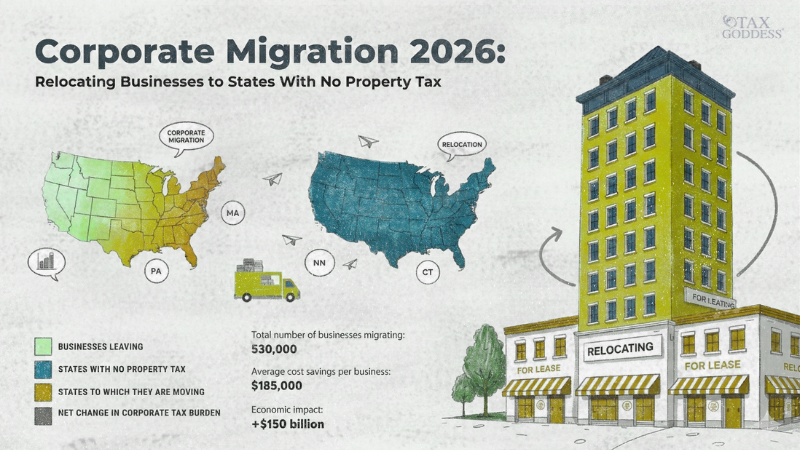
The “Great Corporate Migration” has reached a fever pitch in 2026. Since 2018, over 560 public companies have relocated their headquarters, driven by the search for fiscal sanity in a post-OBBBA world. If you are feeling the “tax squeeze” this season, you aren’t alone—high-tax strongholds like California and New York are seeing record outflows as business owners and high-net-worth individuals “vote with their feet”.
The passage of the One Big Beautiful Bill Act (OBBBA) has rewritten the rules. While it made several business-friendly provisions permanent, it also heightened the competition between states to offer the most attractive tax planning environment.
Which State Has the Best Business Property Tax Rate?
When searching for states with no property tax, it is vital to distinguish between real estate and Business Personal Property (BPP).
The Real Estate Leaders
In 2026, Hawaii remains the national leader for the lowest effective real estate property tax rate at just 0.27%. For a $10 million commercial facility, this represents an annual bill of just $27,000, a fraction of the $200,000+ you might pay in Illinois or New Jersey.
Top 5 States for Low Real Estate Tax (2026):
- Hawaii: 0.27%
- Alabama: 0.38%
- Nevada: 0.47%
- Arizona: 0.48%
- Colorado: 0.48%
The BPP “Tax-Free” Zones
For many businesses, the real victory is in BPP—the tax on machinery, equipment, and furniture. Several states have effectively created “no property tax” zones for small to mid-sized businesses by raising exemption thresholds for 2026:
- Indiana: Now exempts the first $2 million of business personal property.
- Texas: Following the approval of Proposition 9, the BPP exemption has jumped to $125,000 per location.
- Arizona: Has indexed its small business exemption to $269,905 for the 2025-2026 cycle.
Are Business Relocation Expenses Tax Deductible in 2026?
The short answer for 2026: No, not for civilians.
The OBBBA permanently codified the suspension of the moving expense deduction originally introduced by the TCJA. This means:
- Fully Taxable: Any relocation reimbursement you provide to an employee must be reported as taxable wages on their Form W-2 (Boxes 1, 3, and 5).
- Withholding Impact: These payments are subject to federal withholding at a flat 22% rate plus FICA taxes.
- The Exception: Only active-duty military and members of the Intelligence Community (CIA, NSA, DIA) can still receive tax-free moving benefits in 2026.
Pro Tip: To keep talent whole, most 2026 relocations now require a “Tax Gross-Up,” where the employer pays the tax on the moving benefit. A $30,000 move often requires a $45,000+ total outlay to cover these new federal liabilities.
Texas vs. Florida: The 2026 Business Tax Showdown
For real estate investors and HNWIs, the choice often comes down to these two titans. Both offer no state personal income tax, but their 2026 corporate structures differ significantly.
Texas: The Margin Master
Texas does not have a corporate income tax. Instead, it uses a Franchise Tax based on “margin.”
- The $2.65 Million Buffer: In 2026, entities with annualized total revenue at or below $2,650,000 owe $0 in franchise tax.
- The Downside: Texas has some of the highest real estate tax rates in the country, averaging 1.49% to 1.58%.
Florida: The CIT Choice
Florida employs a 5.5% Corporate Income Tax (CIT).
- The Rent Tax Victory: As of 2026, Florida has officially eliminated the commercial rent tax. Following the 2025 repeal, the state sales tax on commercial leases is now 0%, saving Florida business tenants and landlords billions in collective “hidden” property tax.
- OBBBA Decoupling: Crucially, Florida remains decoupled from federal OBBBA rules regarding accelerated bonus depreciation. For Florida CIT purposes, you must add back your 100% federal bonus depreciation and spread that deduction over seven years.
How To Avoid Property Tax Legally?
In 2026, legal avoidance isn’t about hiding assets; it’s about sophisticated reclassification.
- Cost Segregation Studies: This is the “gold standard” for real estate investors. By reclassifying building components (like flooring or specialized wiring) as personal property, you can utilize the OBBBA’s permanent 100% bonus depreciation to write off those assets immediately.
- Qualified Production Property: The OBBBA now allows 100% expensing for certain nonresidential buildings used in manufacturing or production built before 2029.
- Opportunity Zones 2.0: Investing in a QOZ allows you to defer capital gains through 2026 and achieve a permanent 100% exclusion on new gains if held for 10 years.
Maximize Your Savings with Tax Goddess
At Tax Goddess, we specialize in these high-level strategies for real estate investors and business owners. We don’t just “file” your taxes; we engineer them. Our Strategic Tax Coaching (STC) clients pay an average annual tax rate of just 6.92% legally. Whether you are moving to a new state or optimizing your current portfolio, we have the experience to ensure you aren’t overpaying the “government rent” known as property tax.
Frequently Asked Questions
Which states have the lowest property taxes for businesses in 2026?
While no state is 100% tax-free, Hawaii (0.27%) and Alabama (0.38%) have the lowest real estate rates. For personal property, Indiana is a top choice with its $2 million exemption threshold.
Is the “no property tax” movement in Florida real?
Partially. In 2026, Florida is debating HJR 203, which would phase out non-school property taxes for homesteaded primary residences. However, the biggest 2026 win for business owners was the complete repeal of the commercial rent tax, which went into effect in late 2025.
What happened to the commercial rental tax?
Florida was previously the only state to charge a sales tax on commercial leases (the “Rental Tax”). However, as of October 1, 2025, this tax was reduced to 0.0%. In 2026, investors no longer need to factor this “secondary property tax” into their Florida cash flow projections.
Bottom Line
Relocating in 2026 requires more than just a moving truck; it requires a surgical approach to the new federal and state tax codes. From maximizing OBBBA bonus depreciation to selecting a state with aggressive BPP exemptions, the right move can save your business millions.
Disclaimer: Tax laws are subject to change. This content is for educational purposes and does not constitute formal tax or legal advice.
Claim Your Share of $2 Billion in Savings
We’ve helped business owners and investors claim over $2 BILLION in tax savings. Don’t leave your 2026 tax strategy to chance.
Let’s help you shield your wealth from unfair tax rates.
BOOK YOUR FREE CONSULTATION HERE