
Overview
- The Paradigm Shift: The OBBBA completely flips the script on the traditional “always buy used to avoid depreciation” advice.
- A Lucrative IRS Subsidy: Taxpayers can claim a hybrid below-the-line deduction of up to $10,000 annually that stacks perfectly on top of the standard deduction via the new Schedule 1-A, through tax year 2028.
- Strict Criteria Apply: To lock in this deduction, the vehicle must be brand new, weigh under 14,000 pounds, and have its final assembly completed right here in the United States.
- The High-Earner Workaround: While personal income phase-outs apply, savvy business owners can leverage strategic split-allocation methods to bypass these caps entirely.
- The Supreme Vehicle Break: With the sudden sunset of the federal EV credits, this interest write-off has officially become the premier vehicle-related tax strategy for 2026.
For so long, the undisputed rule of the wealth game was simple: never buy a brand-new car. You would drive it off the lot, watch 20% of your capital instantly evaporate into the ether of depreciation, and curse your financial choices. But on July 4, 2025, Uncle Sam decided to tear up the traditional playbook with the historic passage of the One Big Beautiful Bill Act, or OBBBA.
Suddenly, personal car loan interest is no longer a “dead expense”. Under this landmark legislation, the IRS is essentially subsidizing your next new car keys, allowing eligible buyers to write off up to $10,000 in interest per year. As we navigate the 2026 tax landscape, this tax strategy has dramatically compressed the total cost of ownership gap. If you are looking to acquire a new vehicle this year, this unique regulatory shift is about to completely rewrite your financing strategy.
How the Auto Loan Tax Deduction Rewrites Car Financing
Under the previous tax law, interest paid on a personal car loan was treated as non-deductible personal interest. The OBBBA fundamentally changes this, introducing Internal Revenue Code Section 163(h)(4). This provision allows you to deduct up to $10,000 in qualified auto loan interest each year from 2025 through 2028.
To claim this write-off, you will file the brand-new IRS Schedule 1-A. The beauty of this form is that it acts as a hybrid deduction. It sits on Line 13b of your Form 1040, meaning you can claim it even if you take the standard deduction. You get to keep your historically high $32,200 joint standard deduction and stack up to $10,000 of auto interest right on top of it, without altering your core AGI. By offering a massive federal tax subsidy on interest, the government has made the lower financing rates typically offered on brand-new cars incredibly lucrative compared to the higher rates associated with used cars.
Simple Tax Savings Formula:
Interest Owed = (Interest Rate / Payments per Year) x Outstanding Principal
Actual Federal Tax Cut = Qualifying Interest Paid x Your Marginal Tax Bracket
The Strict 2026 Rules of Engagement: What Vehicles Qualify?
Before you run to the nearest dealership, you must understand that the IRS has built strict guardrails to prevent abuse. If your vehicle or loan fails a single metric, your deduction is completely disqualified.
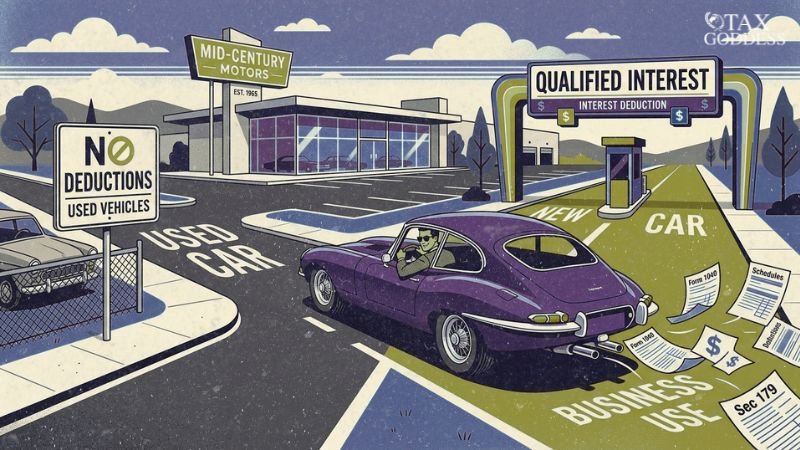
- The Original Use Rule: The vehicle must be absolutely brand new. Pre-owned vehicles, certified pre-owned (CPO) models, and cars purchased at the end of a lease do not qualify under any circumstances.
- Built in the USA: To support domestic manufacturing, the final vehicle assembly (putting the final parts together) must have occurred in the United States. You can verify this by checking the manufacturing label on the driver’s side doorjamb or running the Vehicle Identification Number (VIN) through the National Highway Traffic Safety Administration (NHTSA) decoder. You will need to report this exact VIN on your tax return to claim the write-off.
- Weight and Type Restrictions: The vehicle must be a passenger car, SUV, pickup truck, minivan, van, or motorcycle with a Gross Vehicle Weight Rating (GVWR) of under 14,000 pounds.
- The First-Lien Loan Lock: The loan must be originated after December 31, 2024, and must be secured by a first lien on the vehicle. Personal unsecured loans or borrowing from friends and family will not work.
Strategic Tax Planning for Business Owners: Shifting to Schedule C
If you are a highly successful business owner or high-net-worth individual, you might see the personal income limits and assume this deduction does not apply to you. For personal use, the deduction begins to phase out at a Modified Adjusted Gross Income (MAGI) of $100,000 for single filers and $200,000 for joint filers, disappearing completely at $150,000 and $250,000, respectively.
But here is where sophisticated tax planning comes into play. If you use your vehicle for both business and personal travel, you can execute a highly legal, highly effective split-allocation strategy :
- The More-Than-50% Test: At the time your loan originates, you must reasonably expect to drive the car for personal reasons more than 50% of the time. This is a one-time test evaluated at origination.
- The Proportional Split: If you use the vehicle 40% of the time for business (such as visiting clients or managing operations) and 60% for personal trips, you can deduct 40% of the loan interest as an ordinary business expense on Schedule C under IRC Section 162. The remaining 60% of the interest can then be written off as personal interest on Schedule 1-A.
- The Golden Compliance Rule: You cannot double-deduct the same dollar. To bulletproof this strategy against aggressive audits, you must maintain a meticulous, contemporaneous mileage log to prove your exact business-to-personal ratio.
- Bypassing the Caps: Because business expenses claimed on Schedule C are entirely exempt from the personal $100,000/$200,000 MAGI phase-out limits, this split-allocation strategy allows high earners to salvage a substantial portion of their auto interest write-off that would otherwise be lost.
The Death of the EV Credit and the Supreme Rise of the Interest Write-Off
In the past, luxury car buyers heavily weighed the benefits of federal Clean Vehicle Credits, which offered up to $7,500 for new electric vehicles. However, the landscape has shifted dramatically.
Under the provisions of the OBBBA, the federal New Clean Vehicle Credit (Section 30D), the Used Clean Vehicle Credit (Section 25E), and the Commercial Clean Vehicle Credit (Section 45W) were completely terminated for any vehicle acquired after September 30, 2025.
With those direct credits gone, the auto loan tax deduction stands as the premier federal tax incentive for vehicle purchases in 2026. Because this deduction is entirely fuel-neutral—applying equally to gas-powered vehicles, hybrids, and electric cars—it provides a powerful, protectionist incentive to purchase new, high-end, U.S.-assembled gasoline vehicles while using the tax code to heavily discount the cost of financing.
Frequently Asked Questions
Does the auto loan tax deduction apply to used cars or leases?
No. Under the OBBBA, the deduction is strictly limited to brand-new, previously untitled financed vehicles. Lease payments and interest paid on pre-owned or certified pre-owned (CPO) vehicles are entirely ineligible.
What are the 2026 income limits for the auto loan tax deduction?
For personal use, the deduction begins to phase out at a MAGI of $100,000 for single filers and $200,000 for married couples filing jointly. It is completely phased out once MAGI reaches $150,000 and $250,000, respectively.
How does the OBBBA change my tax strategy for buying a car?
By offering a hybrid below-the-line deduction of up to $10,000 on new vehicle loan interest via Schedule 1-A, the OBBBA heavily subsidizes the total cost of ownership of new, U.S.-assembled vehicles, rendering used-car financing significantly less competitive.
Can I deduct car loan interest if I use the vehicle for business?
Yes. If you pass the 50% personal-use test at origination, you can split the interest proportionally. The business portion is deducted on Schedule C (exempt from income limits), while the personal portion goes on Schedule 1-A.
Bottom Line
The newly enacted interest write-off under the OBBBA has completely rewritten the traditional rules of car financing, creating an incredibly compelling case to buy new and buy American. By aligning your purchasing decisions with these powerful interest deductions—and utilizing smart allocation strategies to bypass high-income phase-outs—you can drive off the lot with a pristine vehicle while keeping your hard-earned capital working for you.
Disclaimer: Tax laws are subject to change. This content is for educational purposes and does not constitute formal tax or legal advice. Always consult with a qualified tax professional regarding your specific situation before implementing any strategies.
Claim Maximum Deductions And Unlock The Lowest Tax Rate With Tax Goddess
Somewhere out there, an IRS agent is having a great year because of people who didn’t optimize their Schedule C write-offs, vehicle acquisitions, and personal deductions. Don’t fund that guy’s bonus. And if you are already funding his bonus and want to stop, but are not sure how, let’s talk.
Tax Goddess has saved clients over $2.3 BILLION and counting. Yes, BILLION! We have helped our clients (business owners like you) legally avoid taxes to the tune of billions.
Book a FREE CALL today, and let’s go over how we can help you keep more money in your pocket.