

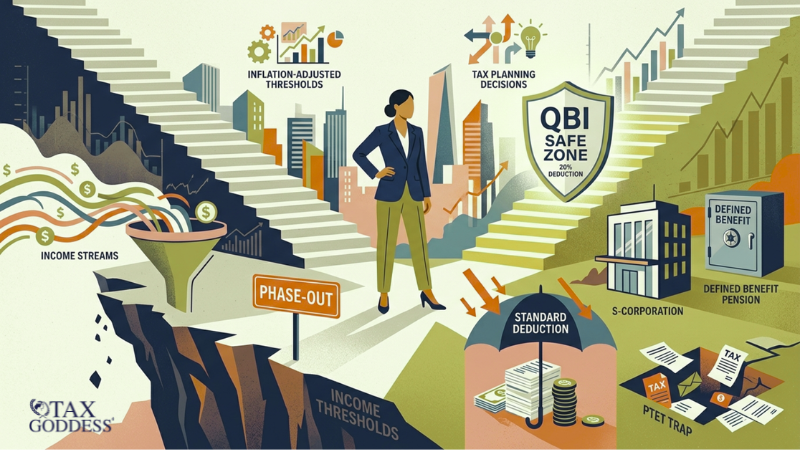
The Overview
- Inflation Protections Widen Brackets: The IRS has finalized the Federal Tax Brackets 2026 under Revenue Procedure 2025-32, adjusting thresholds upward by 2.3% to 3.0% to insulate high earners from artificial bracket creep.
- Permanence and Complexity: The One Big Beautiful Bill Act (OBBBA) permanently codified the 20% Qualified Business Income (QBI) deduction under Section 199A, removing sunset anxiety but adding aggressive phase-out cliffs.
- Standard Deduction Elevation: The 2026 US federal income tax brackets single-filer standard deduction has climbed to $16,100, while joint filers receive $32,200, representing substantial baseline tax shields.
- The PTET Trap: With the individual SALT deduction cap expanded to $40,400, automatically electing the Pass-Through Entity Tax (PTET) at the corporate level is now a critical planning error that can unintentionally erode your QBI write-off.
- Strategic Income Deferral: Elite high earners must actively leverage Defined Benefit pension plans and optimized S-Corporation salary ratios to compress taxable income and stay within the lucrative QBI “safe zone”.
For the sophisticated business owner and high-net-worth investor, standard tax compliance is a losing game. The transition into the 2026 tax year brings a highly progressive ordinary rate schedule alongside specialized statutory deductions that can either multiply your wealth or trigger massive, unexpected tax hikes.
With the passage of the One Big Beautiful Bill Act (OBBBA), the tax landscape has shifted from temporary stopgaps to permanent, highly complex structures. To navigate these changes, you cannot rely on outdated, boilerplate strategies. True tax optimization requires a precise understanding of how the newly adjusted ordinary income tiers interact with your corporate distribution and retirement structures.
Navigating the Progressive Federal Tax Brackets 2026
The progressive nature of the U.S. tax system means your effective tax rate is always significantly lower than your top marginal rate. To mitigate the wealth-eroding effects of inflation, the IRS utilizes annual cost-of-living adjustments to prevent bracket creep. For the 2026 tax year, the bottom two ordinary tax tiers received a larger 4.0% expansion, while the upper tiers adjusted by approximately 2.3% to 3.0%.
To build an airtight defensive tax plan, you must know exactly where the boundaries lie. Below are the finalized ordinary income tax brackets for the 2026 tax year :
2026 US Federal Income Tax Brackets for Single Filer:
- 10% Rate: Taxable income from $0 to $12,400.
- 12% Rate: Taxable income from $12,401 to $50,400.
- 22% Rate: Taxable income from $50,401 to $105,700.
- 24% Rate: Taxable income from $105,701 to $201,775.
- 32% Rate: Taxable income from $201,776 to $256,225.
- 35% Rate: Taxable income from $256,226 to $640,600.
- 37% Rate: Taxable income over $640,600.
2026 US Federal Income Tax Brackets for Married Filing Jointly:
- 10% Rate: Taxable income from $0 to $24,800.
- 12% Rate: Taxable income from $24,801 to $100,800.
- 22% Rate: Taxable income from $100,801 to $211,400.
- 24% Rate: Taxable income from $211,401 to $403,550.
- 32% Rate: Taxable income from $403,551 to $512,450.
- 35% Rate: Taxable income from $512,451 to $768,700.
- 37% Rate: Taxable income over $768,700.
Before these progressive rates are applied, your gross income is reduced by standard or itemized deductions. The standard deduction is a highly effective, automatic income shield. For 2026, the single-filer standard deduction is established at $16,100, while married couples filing jointly receive $32,200.
Demystifying the Section 199A QBI Deduction Permanence
The Section 199A Qualified Business Income (QBI) deduction was originally designed as a temporary incentive, but the OBBBA has officially made the 20% write-off a permanent pillar of the tax code. While this permanence provides business owners with an indefinite planning horizon, the rules governing high earners remain exceptionally strict.
Your eligibility for the full, unreduced deduction hinges entirely on your total taxable income. Under the finalized 2026 guidelines, the critical thresholds are set as follows:
- Single Filers: Full deduction up to $201,750 of taxable income. Above this limit, a $75,000 phase-in window applies, meaning the deduction is subject to strict wage and property limits, or completely eliminated for Specified Service Trades or Businesses (SSTBs) once taxable income reaches $276,750.
- Married Filing Jointly: Full deduction up to $403,500 of taxable income. A wider $150,000 phase-in window applies, with the deduction phasing out entirely for high-earning SSTBs at $553,500.
If you operate an SSTB (such as law, health, consulting, or financial services), crossing these upper limits completely erases your 20% deduction, instantly increasing your federal tax exposure. For Non-SSTBs, crossing the threshold triggers complex wage and property limitation calculations. However, the OBBBA has replaced the previous punitive “all-or-nothing” approach with a graduated system where limitations apply to only 75% of the excess income over the threshold, preserving more value for growing companies.
Strategic Blueprints for QBI Phase-Out Avoidance
S-Corporation Payroll Optimization (The “Sweet Spot” Strategy)
For S-Corporation shareholders, finding the optimal balance between W-2 salary and pass-through distributions is a high-stakes puzzle. S-Corp owner-employee salaries are strictly excluded from QBI. Every dollar you pay yourself in salary reduces the business profit that serves as the base for your 20% QBI deduction.
However, paying yourself too little triggers IRS reasonable compensation audits and caps your QBI write-off under the high-income wage limitation rules (which restrict the deduction to 50% of the company’s total W-2 payroll).
Instead of getting bogged down in dense accounting algebra, elite strategists look for the mathematical “sweet spot” where your wage-based cap aligns perfectly with your raw business profits. For a high-income, asset-light S-Corporation with no other employees, that ideal balance is roughly 28.57% of your business’s net profits before salary (or about 2/7ths of your pre-salary profit).
For example, if your S-Corp generates $300,000 in net profit before paying you, setting your W-2 wage at $85,714 and taking the remaining $214,286 as S-Corp distributions is the most tax-efficient structure. Why? Because the salary is high enough to fully unlock the maximum allowable QBI deduction of $42,857 under the wage-cap rules, while keeping your Social Security and Medicare taxes to the absolute minimum.
Choosing arbitrary salary numbers is highly discouraged. Under the One Big Beautiful Bill Act, the IRS enforces a strict 20% accuracy-related penalty on any tax underpayments resulting from negligent or unsupported reporting, making professional compensation studies essential to back up your strategy.
Pre-Tax Retirement Architecture (Solo 401(k) and Defined Benefit Plans)
The most robust mechanism to pull your taxable income back into the QBI “safe zone” is the aggressive, intentional funding of pre-tax retirement structures. For solopreneurs, a Solo 401(k) allows for pre-tax contributions of up to $24,500 in elective deferrals for 2026, with an additional $8,000 catch-up for those aged 50 or older.
For ultra-high-earning consultants or investors, a Defined Benefit (DB) or Cash Balance plan is the ultimate power play. Depending on your age and actuarial models, these plans allow you to make six-figure annual pre-tax contributions ranging from $150,000 to over $345,000.
By deducting these massive contributions from your Adjusted Gross Income (AGI), you can compress your personal taxable income below the joint phase-out threshold. This dual-benefit strategy simultaneously builds tax-deferred wealth and unlocks the full, unreduced 20% QBI deduction on your remaining pass-through business profit.
Rethinking the Pass-Through Entity Tax (PTET) Workaround
For years, the Pass-Through Entity Tax (PTET) was an automatic choice for S-Corp and partnership owners seeking a workaround to the restrictive $10,000 federal SALT cap. By electing to pay state taxes directly at the corporate level, business owners converted non-deductible personal state taxes into fully deductible business expenses.
However, the OBBBA has disrupted this standard playbook by raising the individual SALT cap to $40,400 for 2026 (subject to a phase-down starting at $505,000 of MAGI).
Because of this dramatic increase in the individual deduction limit, an automatic PTET election can be a very expensive mistake. When state taxes are paid at the entity level via PTET, the corporate-level deduction directly reduces the business’s net profit.
Because QBI is calculated on net profit, this reduction erodes your QBI base and directly shrinks your federal 20% QBI deduction.
If your total state tax liability is under $40,400, skipping the PTET election, paying state taxes individually, and claiming them on Schedule A is often the superior strategy, as it preserves your QBI base and maximizes your federal write-off.
Frequently Asked Questions
What are the 2026 federal tax brackets for single filers?
Under the finalized 2026 federal tax brackets, single filers face seven progressive marginal rates: 10% up to $12,400; 12% to $50,400; 22% to $105,700; 24% to $201,775; 32% to $256,225; 35% to $640,600; and 37% on all taxable income exceeding $640,600.
What is the standard deduction for single filers in 2026?
The 2026 US federal income tax brackets single-filer standard deduction is officially established at $16,100, providing an automatic tax shield that directly reduces your adjusted gross income before marginal rates are applied.
How can high-income single filers optimize their standard deduction?
High earners subject to the 2026 us federal income tax brackets for single filers can leverage bunching strategies, donating multiple years of charitable contributions into a single tax year using a Donor-Advised Fund to comfortably surpass the $16,100 standard deduction threshold.
How do S-Corp wages affect the Section 199A QBI deduction?
W-2 wages paid to an S-Corp owner are excluded from QBI. Higher salary reduces the remaining pass-through profit (QBI base), but if wages are too low, the wage limitation cap (50% of W-2 payroll) will drastically limit the allowable QBI deduction for high earners.
Bottom Line
Mastering the 2026 tax landscape requires looking at your financial structure as a single, cohesive system. By aligning your business entity filings, optimizing S-Corp compensation structures, and strategically timing your pre-tax retirement plan funding, you can successfully bypass the aggressive QBI phase-out limits and keep more of what you build.
Disclaimer: Tax laws are subject to change. This content is for educational purposes and does not constitute formal tax or legal advice. Always consult with a qualified tax professional regarding your specific situation before implementing any strategies.
Minimize Your Taxes Legally with Tax Goddess
Minimizing your tax liability is not about standard deductions; it is about aggressive, customized wealth preservation strategies. Tax Goddess has successfully identified and secured over $2 BILLION in tax savings for clients nationwide.
Do not let bracket creep and complex phase-out cliffs erode your hard-earned wealth this year. Book a Free Consultation with the elite strategist team at Tax Goddess today, and let us build a bespoke, bulletproof plan to protect your assets under the 2026 tax framework.