In 2026, the landscape of estate tax planning has shifted significantly. With the implementation of the One Big Beautiful Bill Act (OBBBA), the federal estate tax exemption has risen to $15 million per individual. While this higher threshold provides a cushion, the complexity of protecting a legacy has only intensified for high-net-worth individuals.
To navigate this, we sat down with Jonathon M. Morrison, a renowned innovator in the estate tax planning space. Jonathon’s background is steeped in the “high-pressure cooker” of Silicon Valley, having practiced with top-tier firms like Wilson Sonsini (the firm behind the IPOs of Apple, Google, and Tesla). Over 20 years, he has designed strategies for some of the world’s wealthiest founders and executives.
If you are interviewing attorneys to handle your estate, Jonathon suggests you ask these nine questions to ensure you are hiring an attorney, not just a document preparer:
1. What is your experience with advanced estate planning?
Advanced tax planning is notoriously brittle. A single word choice, such as “may” versus “shall,” can be the difference between a massive tax bill and a tax-free transfer.
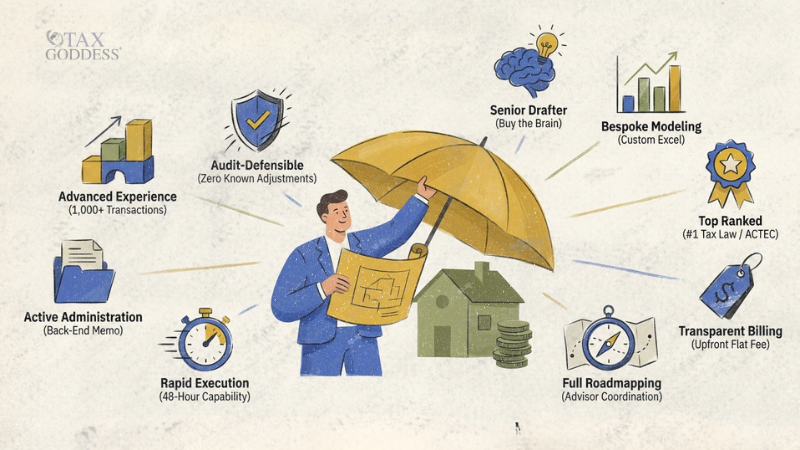
The Benchmark: An attorney should have handled at least several hundred advanced transactions (for example, Jonathon has completed over 1,000). You should also look for thought leadership, such as national speaking engagements or peer-reviewed articles in benchmark national legal journals (such as Estate Planning Journal or Trusts & Estates).
2. Have your transactions ever been audited?
You don’t want to be the “test case” for a new strategy. You want a plan that is “audit-defensible” from day one.
The Benchmark: Ideally, the answer is zero known audit adjustments. Top-tier firms also often have in-house former IRS trial attorneys who defend the trusts they build, often covering the defense fees as part of the initial engagement.
3. Who will personally draft my documents?
Most law firms delegate the actual drafting to junior associates or paralegals to save on costs. This is where the mistakes happen. For litigation and less-complex fields of law, this isn’t usually a deal-breaker. But estate and tax planning is notoriously complex and involves irrevocable trusts that cannot be changed. A clerical error by a junior staffer can be catastrophic.
The Benchmark: You should “buy the brain” of the senior expert. The senior lawyer should personally handle the drafting and every technical aspect to ensure mistakes are not made by juniors.
4. Will you provide bespoke financial modeling?
If an attorney tells you to ask your CPA or financial advisor for the numbers, it’s a red flag. Most general CPAs are not dedicated gift and estate tax experts.
The Benchmark: Your attorney (or a dedicated gift & estate tax specialist) should provide a customized financial model that illustrates the tax and economic benefits of the transaction. This should be part of their service, not an outsourced homework assignment for you.
5. How is your firm ranked in this specific field?
Reputation and depth of resources matter when dealing with complex tax structures.
The Benchmark: Look for boutique firms that specialize exclusively in tax and estate planning within their state and have a significant number of Certified Specialists and members of ACTEC (American College of Trust and Estate Counsel).
6. What is your billing structure?
Hourly billing can lead to unpredictable costs and discourages you from reaching out when your circumstances change.
The Benchmark: A one-time upfront flat fee is the most transparent approach. Ask if this fee covers future amendments, annual meetings, and communications. (Note: These fees are often tax-deductible if they relate to business or charitable planning.)
7. Will you manage the entire “roadmapping” process?
A great estate plan requires coordination between your lawyer, CPA, and investment advisors. You shouldn’t have to act as the project manager.
The Benchmark: The senior lawyer should “architect” the design and manage the entire roadmap, ensuring all advisors are aligned before and after the transaction. Ideally, the design should be offered free of charge (not after $10-20k of hourly fees to find out that the recommended design is not something you’d be interested in).
8. How quickly can you execute?
When it comes to securing your legacy, opportunities don’t wait around for you to catch up.
The Benchmark: An expert who has refined their systems over decades should be able to complete complex transactions in as little as 48 hours if the situation demands it.
9. What happens after the documents are signed?
The most common point of failure in estate planning is poor administration. If you don’t know how to “operate” the trust, the tax benefits could be at risk.
The Benchmark: You and your advisors should receive a detailed “back-end memo” or instruction manual explaining how to operate the structure. The firm should also provide annual reviews to ensure the structure is being administered correctly over time.
The Bottom Line
An estate plan is only as strong as its weakest link, and when it comes to preserving multi-generational wealth, those links are forged in the fine print.
The ultimate takeaway from these nine questions points to choosing an advisory partner who takes active, long-term ownership of your financial safety net.
True wealth protection isn’t a static document you sign once and tuck away in a drawer. It is a dynamic, living financial engine that must coordinate seamlessly with your entire advisory team, model real-time economic shifts, and guarantee bulletproof defense-readiness long after the ink has dried.
When the future of your wealth and family’s legacy is on the line with irrevocable trust structures, do not spare expense: you need absolute, unquestionable certainty.
Meet the Expert: Jonathon M. Morrison, JD
Jonathon is a Senior Partner at Frazer Ryan Goldberg & Arnold LLP (consistently ranked Arizona’s #1 Tax Law firm) and is a Certified Specialist in Estate Planning, Trust & Probate Law.
An industry pioneer, he is celebrated for developing advanced tax solutions featured on the cover of the national Estate Planning Journal, including the Optimized Gift Trust (OGT), the Optimized CLAT (OCLAT), and the Marital Multiplier Trust (MMT). Over his career, he has executed more than 1,000 total transactions, including over 500 highly complex structures like SLATs, GRATs, and Asset Protection Trusts.
Jonathon holds a B.S. in Accounting and Finance (cum laude) from the University of Arizona’s Eller College of Management and a J.D. specializing in Taxation from UC Hastings. When he is not designing tax shields, he is an avid performance car enthusiast and Ferrari collector.
Disclaimer: Tax laws are subject to change. This content is for educational purposes and does not constitute formal tax or legal advice. Always consult with a qualified tax professional regarding your specific situation before implementing any strategies.
Shield Your Wealth With Tax Goddess
We don’t believe in “one-size-fits-all” templates or passive, reactive planning. At Tax Goddess, we specialize in helping high-performing founders, investors, and business owners align their corporate entities with world-class, audit-defensible estate structures.
With over $2.05 BILLION in tax savings identified for our clients, we know what it takes to build a legacy that endures. Let’s make sure your hard-earned wealth stays exactly where it belongs.