
The Overview (TL;DR)
- Cost Segregation Studies are engineering-based tax analyses that separate a building into individual components, allowing property owners to write off assets over 5, 7, or 15 years instead of waiting 27.5 or 39 years.
- Permanent 100% Bonus Depreciation: Under the One Big Beautiful Bill Act (OBBBA), qualifying property acquired and placed in service after January 19, 2025, qualifies for permanent 100% bonus depreciation.
- Immediate Cash Flow: Separating Section 1245 property (personal property) from Section 1250 property (building structure) can move 20% to 40% of your depreciable basis (excluding land) into rapid write-offs.
- Qualified Improvement Property (QIP) lets you deduct nonresidential commercial interior build-outs over 15 years, making them 100% bonus eligible.
- Offsetting Active Income: High earners can use cost segregation deductions to offset active business income and W-2 salaries by qualifying for Real Estate Professional Status (REPS) or using the Short-Term Rental (STR) 7-day rule.
- 2026 Loss Limits: Active losses are capped by the Section 461(l) Excess Business Loss rule at $256,000 for single filers and $512,000 for married couples filing jointly in 2026 (Rev. Proc. 2025-32).
- No Amended Returns Needed: You can claim years of missed depreciation on properties you already own using IRS Form 3115 and a one-time Section 481(a) catch-up deduction on this year’s tax return.
Every spring, profitable business owners and real estate investors write painful checks to the IRS. You bought commercial real estate or built a residential rental portfolio to create long-term wealth, but your tax return tells you that your $2 million building must be written off in slow annual increments over 27.5 or 39 years. You spent your hard-earned cash today, but the government expects you to wait nearly four decades to recover your investment.
Recovering your investment over nearly four decades forces your capital to fight a losing battle against inflation. A deduction received in the 2060s is worth only a fraction of that same deduction taken on this year’s tax return.
Under official IRS guidance in Publication 5653 (the Cost Segregation Audit Techniques Guide), commercial and residential rental properties do not have to be treated as single, indivisible structures. Furthermore, the One Big Beautiful Bill Act (OBBBA) permanently restored 100% bonus depreciation under IRC § 168(k) for qualifying property acquired and placed in service after January 19, 2025, eliminating the scheduled phase-down.
If you want to reduce your tax bill and reinvest that capital into your business right now, this guide explains how Cost Segregation Studies work, how to execute them cleanly, and how high-income earners use them to accelerate their deductions.
How Cost Segregation Studies Accelerate Cash Flow
What Are Cost Segregation Studies and How Do They Work?
When you purchase or construct a building, the purchase price (minus land value) goes onto a depreciation schedule. By default, the IRS assigns:
- 27.5 years for residential rental property (apartments, single-family rentals).
- 39 years for commercial property (offices, retail storefronts, warehouses, medical clinics).
Under straight-line depreciation, a $2,000,000 commercial building gives you a modest write-off of roughly $51,282 per year.
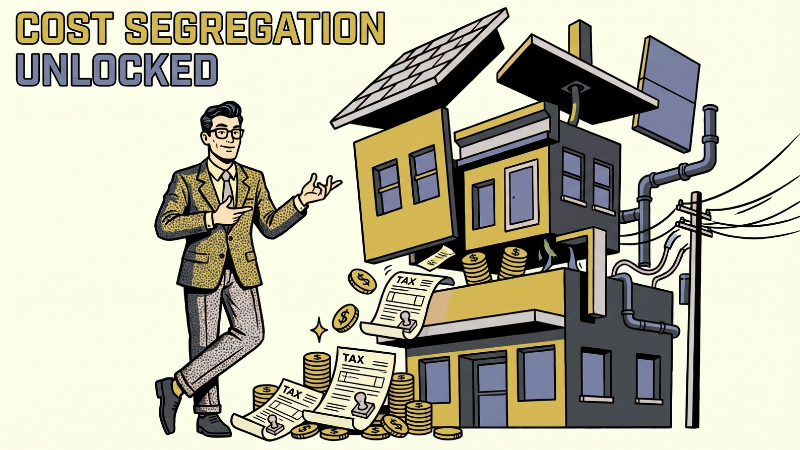
A cost segregation study is an engineering analysis of your property. A team of engineers and tax professionals examines architectural blueprints, contractor invoices, and on-site installations to identify components that do not belong in a 39-year bucket. Instead, those components are reclassified into short-lived buckets of 5, 7, or 15 years.
Typically, an engineering study successfully reclassifies 20% to 40% of a property’s depreciable basis into faster categories, creating immediate write-offs in the first year.
Categorizing Your Assets: Section 1245 Property vs. Section 1250 Property
To apply cost segregation correctly, tax law divides real estate into distinct categories:
Section 1245 Property (5-Year or 7-Year Personal Property)
Section 1245 property covers tangible personal property dedicated to business operations or tenant convenience, rather than the building’s permanent structural frame. These items are depreciated over 5 or 7 years using the accelerated 200% declining-balance method.
- Examples: Removable carpeting, vinyl plank flooring, dedicated electrical circuits for machinery or appliances, decorative accent lighting, kitchen cabinetry, specialty millwork, and security surveillance systems.
Land Improvements (15-Year Property under Section 1250)
Land improvements include outdoor additions located on your parcel outside the main building. They are depreciated over 15 years using the 150% declining-balance method.
- Examples: Concrete sidewalks, asphalt parking lots, curbs, exterior drainage basins, fences, outdoor lighting poles, and decorative shrubbery.
Qualified Improvement Property (QIP)
Qualified Improvement Property includes interior, non-structural improvements made to commercial buildings after the building was first placed in service. QIP is classified as 15-year property and is eligible for 100% bonus depreciation.
- Examples: Interior drywall reconfigurations, interior doors, finish carpentry, and upgraded commercial lighting.
- Exclusions: Building expansions, elevators, escalators, and structural framing.
Section 1250 Property (27.5-Year or 39-Year Building Structure)
Section 1250 property consists of the permanent structural shell and standard systems required to operate and maintain the building.
- Examples: Foundation footings, load-bearing walls, structural steel, roofing, standard windows, general HVAC units, restrooms, and primary electrical distribution panels.
| Asset Category | Tax Classification | Recovery Period | Real-World Examples |
| Personal Property | Section 1245 | 5 or 7 years | Removable flooring, accent lights, cabinetry, dedicated equipment outlets |
| Land Improvements | Section 1250 | 15 years | Parking lots, curbs, exterior drainage, fencing, outdoor landscaping |
| Qualified Improvement Property (QIP) | Section 1250 / 168(e)(6) | 15 years | Commercial interior renovations (drywall, lighting, doors) |
| Building Structure | Section 1250 | 27.5 or 39 years | Foundations, load-bearing walls, structural roofs, main HVAC and plumbing |
Maximizing Your Savings with 100% Bonus Depreciation
Moving assets into 5-, 7-, or 15-year recovery periods produces accelerated depreciation. Combining cost segregation with bonus depreciation under IRC §168(k) provides the primary tax savings.
Under the Tax Cuts and Jobs Act (TCJA) of 2017, bonus depreciation had been phasing down:
- 2023: 80% bonus
- 2024: 60% bonus
- 2025 (Property acquired under a binding written contract entered into on or before January 19, 2025): 40% bonus
The Permanent 100% Bonus Rule (OBBBA)
The One Big Beautiful Bill Act changed this phase-down schedule.
Current Law (OBBBA): For qualifying property acquired and placed in service after January 19, 2025, bonus depreciation is permanently set at 100%. Under Treas. Reg. § 1.168(k)-2(b)(5), property acquired pursuant to a binding written contract executed on or before January 19, 2025, remains bound by the earlier 40% rate, regardless of when it is placed in service.
Every asset identified in a cost segregation study with a recovery life of 20 years or less (including 5-, 7-, and 15-year assets, as well as QIP) can now be deducted 100% in Year One. Unlike Section 179 expensing, bonus depreciation has no cap on total purchase volume and applies to both new construction and acquired existing buildings.
Example: $2,500,000 Commercial Building Acquisition
Consider an investor who buys a commercial office building for $2,500,000, allocating $500,000 to land and leaving a $2,000,000 depreciable building basis:
- Without Cost Segregation: The investor claims straight-line depreciation of roughly $51,282 per year.
- With Cost Segregation (assuming 25% reclassified into 5- and 15-year property):
- 5-Year Personal Property: $300,000 (100% bonus) = $300,000 deduction
- 15-Year Land Improvements: $200,000 (100% bonus) = $200,000 deduction
- 39-Year Building Shell: $1,500,000 straight-line = $38,462 deduction
- Total First-Year Deduction: $538,462
Assuming a married couple filing jointly where one spouse qualifies for Real Estate Professional Status (REPS) under IRC § 469(c)(7) and has sufficient net business income to absorb the Section 461(l) threshold, this strategy generates an immediate first-year federal tax reduction of $199,231 at the top 37% bracket ($538,462 x 37%).
(Note: For an investor without REPS, this paper loss remains passive and is suspended to offset future net rental income or capital gains upon disposition).
Real Estate Tax Planning: How High Earners Offset Active and W-2 Income
A large paper deduction is valuable only if the IRS allows you to use it against your taxable income. Under IRC Section 469, rental real estate is classified as per se passive. By default, passive rental losses can offset only passive income—they cannot offset active business profits or W-2 wages.
To use cost segregation deductions against active business earnings or salary, high earners rely on two strategies:
Strategy 1: Real Estate Professional Status (REPS)
Under IRC §469(c)(7), a taxpayer can overcome the passive loss restriction if they qualify as a Real Estate Professional:
- 750-Hour Rule: Spend more than 750 hours during the year working in real property trades or businesses.
- 50% Rule: Spend more than half of your total working time during the year in real estate businesses.
- Material Participation: Materially participate in your rental operations under Treasury Regulation § 1.469-5T. Taxpayers with multiple properties should make a formal grouping election under Treasury Regulation § 1.469-9(g) to treat all rental real estate interests as a single activity, allowing combined hours to satisfy one of the statutory material participation tests.
Note for married couples: One spouse must meet both the 750-hour and 50% tests independently. If one spouse works a full-time corporate W-2 job, the other spouse can qualify for REPS, allowing the couple filing jointly to offset their household W-2 income.
Strategy 2: The Short-Term Rental (STR) Exception
For high earners who work full-time corporate jobs and cannot meet the 50% real estate time requirement, the Short-Term Rental exception provides an alternative approach.
Under Treasury Regulation § 1.469-1T(e)(3)(ii)(A), a property is not considered a “rental activity” if the average guest stay is 7 days or less.
If your property meets this 7-day rule, you do not need Real Estate Professional Status. You only need to show material participation under Treasury Regulation § 1.469-5T. Common qualifying standards include:
- Spending 500 hours managing the property during the year.
- Doing substantially all the work yourself.
- Spending more than 100 hours managing the property, and at least as much time as any other individual (including cleaners or handymen).
Meeting the 7-day rule and a material participation test treats your accelerated depreciation deductions as non-passive losses, which can directly offset your W-2 salary or business income.
The 2026 Hurdle: Section 461(l) Excess Business Loss (EBL) Limits
Once your losses are classified as active, they face one final statutory limit: IRC Section 461(l). The OBBBA permanently extended the Excess Business Loss restriction.
Under Section 461(l), business deductions cannot exceed your total business income plus an annually adjusted threshold. Any business loss above the threshold is disallowed for the current year and converted into a Net Operating Loss (NOL) under IRC §172, which can offset up to 80% of taxable income in future years.
IRC §461(l)(3)(A)(ii) excludes W-2 wages from business income. A salary cannot be used to absorb business losses under this calculation.
2026 Inflation Adjustments (Rev. Proc. 2025-32)
Because the OBBBA reset the statutory base year for inflation calculations, the EBL threshold decreased for 2026:
- 2025 Threshold: $313,000 for single filers; $626,000 for married filing jointly (Rev. Proc. 2024-40).
- 2026 Threshold: $256,000 for single filers; $512,000 for married filing jointly (Rev. Proc. 2025-32, Sec. 4.31).
If a married couple has $1,500,000 in W-2 wages and generates an $800,000 active cost segregation loss from a short-term rental in 2026, they can deduct $512,000 against their salary in 2026. The remaining $288,000 carries forward as an NOL into 2027.
The “Look-Back” Study: Claiming Missed Deductions Without Amending Returns
If you purchased a property two, five, or ten years ago and claimed standard straight-line depreciation, you can still claim those missed deductions without filing amended tax returns.
Claiming straight-line depreciation on two or more consecutively filed tax returns establishes an accounting method. To switch to accelerated depreciation, you file IRS Form 3115 (Application for Change in Accounting Method) concurrently with your timely filed federal income tax return under Designated Change Number (DCN) 7 pursuant to Revenue Procedure 2025-23.
- No Filing Fee: Automatic method changes carry no IRS user fee.
- Section 481(a) Adjustment: You and your tax strategist calculate the cumulative difference between the depreciation claimed to date and the depreciation you were legally entitled to claim via cost segregation. That entire difference is claimed as an immediate, lump-sum negative adjustment on your current return.
- Historical Bonus Rates: Catch-up depreciation uses the bonus rate in effect when the property was placed in service. If you acquired the property in 2022, your reclassified 5- and 15-year components receive the full 100% bonus write-off today.
The Exit Reality: Planning for Depreciation Recapture
Cost segregation accelerates deductions into early years, functioning as an interest-free loan from the IRS rather than permanent tax elimination. When the property is sold, those accelerated deductions are subject to recapture:
- Section 1245 Recapture: Gain attributable to 5- and 7-year personal property components is recaptured and taxed at ordinary income rates (up to 37%) under IRC § 1245, rather than preferential capital gains rates.
- Unrecaptured Section 1250 Gain: Depreciation claimed on the 27.5-year or 39-year building structure is taxed at a maximum federal rate of 25% under IRC § 1(h)(1)(D).
Experienced real estate investors manage this tax exposure through two strategies:
- IRC § 1031 Like-Kind Exchanges: Rolling sale proceeds into replacement real estate defers both capital gains and Section 1250 recapture. However, because Section 1245 personal property is not like-kind to real estate, the replacement property must contain sufficient Section 1245 property to absorb that basis and prevent taxable “recapture boot.”
- Step-Up in Basis at Death: Holding real estate until death permanently wipes out both accumulated depreciation recapture and capital gains taxes under IRC § 1014, providing heirs with a stepped-up Fair Market Value basis.
Protecting Your Deductions: IRS Audit Red Flags to Avoid
To withstand examination, a study must adhere to Chapter 4 of the IRS Cost Segregation Audit Techniques Guide (Publication 5653), which establishes 13 principal quality elements.
Audit triggers examiners look for include:
- Rule-of-Thumb Software Estimates: Studies generated using generic software without an on-site physical inspection carry higher audit risk.
- Contingency Fees: The IRS scrutinizes studies where the provider’s fee is tied to a percentage of tax savings, as this creates an incentive to over-allocate basis.
- Unrealistic Land Allocations: Assigning an arbitrarily low percentage of value to land (such as under 10%) can trigger adjustments for basis inflation.
- Poor STR Participation Logs: Failing to keep contemporaneous records of hours spent managing a short-term rental can result in losses being reclassified as passive.
Disallowed studies can trigger accuracy-related penalties under IRC Section 6662, ranging from 20% for negligence to 40% for gross valuation misstatements.
4. Frequently Asked Questions
What is a cost segregation study?
A cost segregation study is an engineering-based tax analysis that separates personal property and land improvements from a building structure. This accelerates depreciation deductions from 27.5 or 39 years into 5, 7, or 15 years, increasing immediate cash flow.
What is the difference between Section 1245 and Section 1250 property?
Section 1245 property consists of tangible personal property like carpeting, specialized electrical systems, and cabinetry depreciated over 5 to 7 years. Section 1250 property includes structural components like walls, roofs, and foundations depreciated over 27.5 or 39 years, plus 15-year land improvements.
What is Qualified Improvement Property (QIP)?
Qualified Improvement Property consists of interior, non-structural alterations made to nonresidential commercial real estate after the building is placed in service. QIP is classified as 15-year property and qualifies for 100% bonus depreciation.
What is the bonus depreciation rate for 2026?
Under the One Big Beautiful Bill Act (OBBBA), bonus depreciation is permanently set at 100% for qualifying assets acquired and placed in service after January 19, 2025, allowing immediate first-year expensing of short-lived property.
Can cost segregation offset W-2 or active business income?
Yes, but you must clear passive activity rules. You must either qualify for Real Estate Professional Status (REPS) or operate a short-term rental with an average stay of 7 days or less while meeting IRS material participation standards.
What is the 2026 Excess Business Loss limit under Section 461(l)?
Under Revenue Procedure 2025-32, the 2026 excess business loss cap is $256,000 for single filers and $512,000 for married couples filing jointly. Losses exceeding this limit convert into Net Operating Loss carryforwards.
Do I have to amend prior tax returns to claim missed depreciation?
No. You file IRS Form 3115 under Designated Change Number 7 with your current tax return, claiming all cumulative missed deductions in a single Section 481(a) adjustment without amending earlier returns.
What triggers an IRS audit on a cost segregation study?
Audits are commonly triggered by software-only “rule of thumb” estimates, lack of physical site inspections, contingency-fee arrangements, aggressive basis allocations away from land, or failure to document material participation on short-term rentals.
Bottom Line
Cost segregation studies offer commercial property owners and active real estate investors a proven way to accelerate depreciation deductions into Year One. This approach frees up working capital that can be used to grow operations, acquire additional assets, and build enterprise value.
Applying permanent 100% bonus depreciation alongside Section 469 passive activity rules and Section 461(l) loss caps requires coordinated engineering and proactive tax planning.
Disclaimer: This publication is for educational purposes only and does not constitute formal legal, accounting, or tax advice. Consult a qualified tax strategist or CPA before implementing any advanced depreciation strategies.
Take Control of Your Tax Strategy with Tax Goddess
Are you ready to stop sending six-figure checks to the IRS and start putting that capital back into your business?
At Tax Goddess, we specialize in advanced, proactive tax reduction strategies for business owners, high-net-worth entrepreneurs, and commercial real estate investors across the United States. Our team develops proactive roadmaps that have generated over $2.43 BILLION in verified tax savings for our clients.
Don’t let valuable accelerated depreciation sit unclaimed in your properties.
BOOK A FREE CONSULTATION WITH TAX GODDESS TODAY and let our tax strategists build a custom cost segregation and tax reduction blueprint for your portfolio!