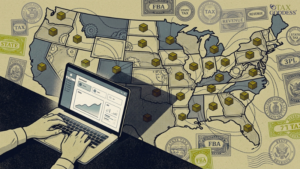
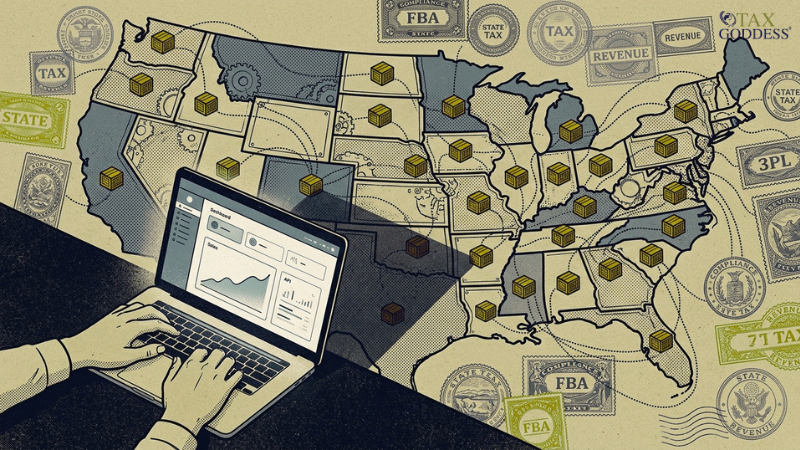
Say you sell candles from Atlanta. Your Shopify store has a good year, you start using Amazon FBA in the spring, and by fall you’ve done about $700,000 in sales. You’ve collected Georgia sales tax since your first order. You haven’t collected it anywhere else.
That’s probably a problem. Amazon spread your inventory across warehouses in several states, and inventory stored in a state generally creates a tax obligation there from the day it arrives. Your direct sales to North Carolina passed $100,000 in August, which crossed that state’s threshold. Your Ohio sales never came close to $100,000, but Ohio also counts orders, and you passed 200 of those before spring.
None of this shows up on your Shopify dashboard. It usually shows up a few years later, in a letter from a state revenue department, with a bill for tax you never charged your customers.
Below is how each of those triggers works, what changed in 2026, and what to do if you’re already behind.
Key takeaways
- You owe sales tax in a state once you have nexus there, either through a physical presence (inventory, employees) or by crossing its economic threshold.
- Most states set the threshold at $100,000 in sales into the state. California, Texas and New York use $500,000, and Alabama and Mississippi use $250,000.
- Transaction-count tests are fading. Kentucky dropped its 200-order test on August 1, 2026, but more than a dozen states still use one.
- Inventory in an Amazon FBA or 3PL warehouse generally creates nexus in that state, no matter how little you sell there.
- Marketplaces collect tax on their own orders, but many states still count those sales toward your threshold for direct sales.
What is sales tax nexus?
Nexus is the connection to a state that lets it require you to collect its sales tax. Once you have it, you need a sales tax permit, you charge the correct rate at checkout, and you file returns and send the money in on the state’s schedule. Without nexus, you don’t collect that state’s tax.
Nexus used to require a physical presence, like a store, office or warehouse. That changed in 2018 with South Dakota v. Wayfair, Inc., when the Supreme Court ruled that states can require collection based on sales volume alone. Every state with a statewide sales tax, plus D.C., now does.
Five states have no statewide sales tax: Alaska, Delaware, Montana, New Hampshire and Oregon. Alaska is the one that catches sellers off guard. Many Alaska cities and boroughs charge local sales tax, and they enforce a shared $100,000 threshold through the Alaska Remote Seller Sales Tax Commission.
There are two ways to get nexus: physical presence and economic activity. You can have one, both, or neither in any given state.
Physical nexus: the warehouse problem
Physical nexus starts the moment your business has a real presence in a state, and most states set no sales minimum for it. The common triggers:
- Inventory in a warehouse, including Amazon FBA and third-party logistics (3PL) providers. FBA catches the most sellers, because Amazon decides where your stock goes and can move it between states without asking you. Amazon’s inventory reports show which fulfillment centers hold your units.
- Employees who work from home in a state, and sales reps who travel there to sell.
- Property you own or lease there, such as an office, showroom or equipment.
- In-person selling at trade shows or pop-ups, in some states. Several states exempt short appearances, so check before you assume either way.
A freelancer who doesn’t sell for you, like a contract designer or copywriter, generally doesn’t create sales tax nexus. A full-time employee in the same city usually does.
One gray area: if every sale into a state goes through a marketplace that collects the tax, states differ on whether FBA inventory there still requires you to register. If you also sell direct into that state, plan on registering.
Economic nexus: when sales alone are enough
Economic nexus depends only on how much you sell into a state. Most states draw the line at $100,000 in sales over a set period. These are the ones that don’t:
| State | Sales threshold | Transaction test | Watch for |
| California | $500,000 | None | Marketplace sales count toward it |
| New York | $500,000 | And more than 100 sales | Both tests must be met, over the preceding four sales tax quarters |
| Texas | $500,000 | None | Optional flat local rate (see sourcing below) |
| Alabama | $250,000 | None | Marketplace sales excluded |
| Mississippi | $250,000 | None | Marketplace sales excluded |
| Connecticut | $100,000 | And 200 sales | Both tests must be met |
The 200-transaction test is fading
South Dakota’s original law used “$100,000 in sales or 200 transactions,” and many states copied it. That test punished low-price sellers: at $5 a sticker, 200 orders is $1,000 in sales.
States have been dropping it. The Alaska commission removed it January 1, 2025, Utah on July 1, 2025, and Illinois on January 1, 2026. Kentucky followed on August 1, 2026, so Kentucky nexus now depends on $100,000 in gross receipts in the current or previous calendar year. If you registered in Kentucky only because of order count, you may be able to close that account. Confirm with an advisor before you do.
The test isn’t gone, though. As of Avalara’s April 2026 count, 14 states besides Kentucky, plus D.C., still trigger nexus at $100,000 or 200 transactions, whichever comes first. That includes Georgia, Michigan, Minnesota, New Jersey, Ohio, and Virginia.
What counts, and when
Two sellers with identical sales can get different answers, because states measure differently:
- The period. Some use the current or previous calendar year. Others use a rolling 12 months or the last four quarters.
- The sales. Some count gross sales, including exempt items. Others count only taxable or retail sales.
- Marketplace orders. Some include them; others don’t.
For example, Florida counts only taxable remote sales made outside a marketplace in the previous calendar year, while Illinois looks at gross receipts over the preceding 12 months. Check each state’s rule against your own sales report, not a single national number.
Where to collect: sourcing rules
Once you have nexus, the rate you charge depends on where the order is delivered. For remote sellers, nearly every state uses destination-based sourcing: you charge the combined state and local rate at the buyer’s shipping address. That rate can differ between two houses on the same street, because city, county and special district taxes stack on top of the state rate.
About a dozen states use origin-based sourcing, which bases the rate on the seller’s location. That mostly matters for sellers based in those states, not for sellers shipping in from outside.
Texas offers a shortcut. Remote sellers can elect a single local use tax rate instead of tracking every local jurisdiction. For 2026 that rate is 1.75%, for a flat 8.00% combined with the 6.25% state rate. The rate is reset every year, and you must notify the Comptroller before you start using it.
Selling on Amazon, Walmart or Etsy
Amazon, Walmart, eBay, Etsy and similar platforms are marketplace facilitators. Every state with a sales tax requires them to collect and remit tax on orders placed through their sites, so you don’t collect on those orders yourself.
That doesn’t take you fully off the hook:
- Your threshold may still include those sales. Many states, including California, count marketplace orders toward your threshold. Sell $495,000 into California through Amazon and $10,000 through your Shopify store, and you’re over the $500,000 line. You now have to register and collect on the Shopify orders. Other states, such as Alabama and Mississippi, leave marketplace sales out. Published sources disagree on several states, so confirm with each state’s revenue department.
- Product categories are still your job. If you assign the wrong tax category in the platform, the marketplace may charge the wrong amount, and the state can come to you for the difference.
- Registration can still be required. If you hold a permit in a state, you keep filing there even when the marketplace collected everything (more on zero returns below).
What’s taxable varies too
Nexus tells you where you owe. Taxability tells you what’s taxed, and it differs more than most sellers expect.
- Clothing. Pennsylvania, Minnesota and New Jersey exempt most clothing. Other states tax it fully, and a few exempt items under a price cap.
- Digital products and software. E-books, downloads, online courses and SaaS are taxed in some states and exempt in others, and the definitions don’t line up.
- Shipping. Some states tax delivery charges when the item itself is taxable. Others don’t tax them if they’re listed separately on the invoice.
- Wholesale orders. Sales to resellers are generally exempt if you collect a valid resale certificate. Keep it on file, because without it the state can treat the sale as taxable.
Most e-commerce platforms let you assign a tax category to each product. Set them carefully once, and review them whenever you add a new type of product.
Registering, filing, and late costs
Register before you collect. Most states don’t allow you to charge sales tax without a permit, and each state sets its own start date after you cross a threshold. Some expect you to register right away; others by the start of the next month or the next calendar year.
Once you’re registered, the state assigns a filing schedule: monthly, quarterly or annual. You file on that schedule even when you owe nothing, including periods where the marketplace collected every order. These are called zero returns, and missing them is one of the most common and avoidable penalties.
Late penalties vary widely. Four of the largest states:
| State | Penalty | Worth Knowing |
| California | 10% of the tax due | Intentionally evading $25,000 or more in a 12-month period can be charged as a felony |
| New York | A one-time 10% of the tax due, minimum $50, even on a late zero return | Interest accrues daily at a floating rate, 11% a year for 2026 |
| Florida | 10% for the first month plus 1% per extra month, up to 30%, minimum $50 | More than 60 days late, the penalty is at least the lesser of $100 or 100% of the tax due |
| Texas | 5% if 1 to 30 days late, 10% after that | Plus a $50 fee for each late report |
Interest is charged on top of penalties, and states rarely waive it.
Already crossed a threshold without collecting?
If you had nexus and didn’t collect, the tax you should have charged is now your cost. The goal is to limit how much of it you pay, and how much extra.
Voluntary disclosure agreements (VDAs). Most states let you come forward before they contact you, often anonymously through a representative at first. In exchange, they typically limit the lookback to three or four years instead of every year you had nexus, and waive most or all penalties. You still owe the tax and, in most states, the interest.
Two cautions. Tax you collected from customers but never sent in is often handled more strictly; Florida’s program, for example, charges a 5% penalty on it. And once a state contacts you, the VDA option usually closes, so don’t wait for the letter.
Streamlined Sales Tax (SST). The SST program has 23 full member states that share definitions and one registration system. Eligible remote sellers can use a Certified Service Provider whose fees the member states cover, for sales into those states. California, Texas, New York, Florida, Illinois and Pennsylvania are not members, so SST won’t help with your obligations there.
Sales tax nexus isn’t income tax nexus
The same FBA inventory or remote employee that creates a sales tax obligation can also trigger income, franchise or gross receipts tax filings in that state. These are separate taxes with separate rules.
A federal law, P.L. 86-272, shields some sellers of physical goods from state income tax when their only in-state activity is soliciting orders. Storing inventory in a state generally goes beyond that, and the law doesn’t apply to gross receipts taxes at all. When you register for sales tax in a new state, ask the income tax question at the same time.
What to do next
- Export sales by state from every channel (your store, Amazon, Etsy, wholesale) for the last two calendar years and the last 12 months.
- Compare each state to its threshold, using that state’s measurement period and definition of sales.
- List every state where you store inventory or have employees. For FBA, pull Amazon’s inventory reports.
- If you’ve had nexus somewhere without collecting, talk to an advisor about voluntary disclosure before you register there.
- Register in the remaining states where you have nexus, before you start collecting.
- Turn on tax collection for those states in your store, and check every product’s tax category.
- Put every filing due date on a calendar, zero returns included.
- Rerun the threshold check every quarter.
Frequently asked questions
Do I need a sales tax permit if I only sell on Etsy?
Often not. Etsy collects and remits tax on Etsy orders in every state with a sales tax. You’d still need a permit where you have physical nexus, such as an employee or stored inventory, or where direct sales from your own site cross a threshold.
I crossed a threshold last year and didn’t notice. What now?
Talk to an advisor before you register or file anything. In some states, registering or filing past returns on your own can make you ineligible for a voluntary disclosure agreement’s shorter lookback and penalty relief. An advisor can usually sequence it so you start collecting soon and still resolve the past through a VDA.
Can I stop collecting if my sales drop below a threshold?
Sometimes. Many states let you close your account after a full measurement period below the threshold, but the rules vary. Physical nexus, like FBA inventory, keeps you in regardless of sales.
Do digital products count toward thresholds?
In many states, yes. Kentucky’s $100,000 threshold, for example, includes digital property and services. Whether the digital products themselves are taxable is a separate, state-by-state question.
Not sure where you stand?
Tax Goddess works with e-commerce owners on exactly this: a nexus review across every channel you sell through, voluntary disclosure for past exposure, registration in new states, and the income tax side of multistate selling that sales tax software doesn’t cover.
If you’ve grown fast, added FBA, or just aren’t sure which states you owe, finding out now costs far less than finding out from an audit notice.
We’ve helped business owners like you save more than $2.43 BILLION in taxes. So, if you are serious about cutting your taxes and keeping more money in your pocket legally, book a free consultation with Tax Goddess today!
Sales tax rules change often. This article is general education as of the date above, not tax or legal advice for your situation.