

The Overview (TL;DR)
- Understanding the brackets: Comparing married filing separately vs jointly tax brackets reveals that separate brackets are set at exactly 50% of the joint thresholds across all seven federal income tax tiers.
- The default choice: Married Filing Jointly (MFJ) remains the standard choice for most households because it combines income to maximize deductions, widens lower tax brackets, and protects valuable tax credits.
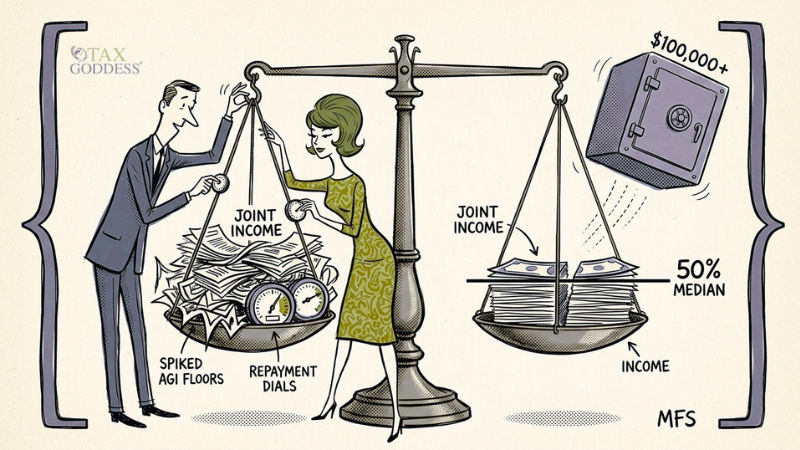
- The six-figure upside: Electing Married Filing Separately (MFS) can save business owners and high-net-worth families $100,000 or more in targeted scenarios, including federal student loan repayment plans, catastrophic medical write-offs, stock option exercises, and legal asset protection.
- The structural trade-offs: MFS strictly eliminates popular deductions and credits, slashes the Roth IRA contribution threshold to near zero, and requires both spouses to use the same deduction method.
- Strategic flexibility: You can legally switch from MFS to MFJ up to three years after the return due date, giving you room to test strategies without losing retroactive tax savings.
Marriage is often described as an emotional, lifelong commitment. But the Internal Revenue Service views it through a very different lens: an automatic corporate merger. The moment you exchange vows, Uncle Sam merges your financial balance sheets, pools your revenues, and applies a tax formula that often treats successful business owners and high earners as a single, heavily taxed economic engine.
Following the passage of the One Big Beautiful Bill Act (OBBBA) and the release of IRS Revenue Procedure 2025-32, the federal tax rules for 2026 have locked in major rate schedules and standard deduction levels. For most couples, filing jointly produces lower tax bills because of bracket pooling. However, for high-income earners, business founders, and specialized professionals, treating your tax returns as separate entities can uncover massive financial advantages.
Under specific legal and financial conditions, choosing to file separately rather than jointly does not just shave off a few hundred dollars; it can rescue six figures of capital from federal clawbacks and liabilities.
Understanding the 2026 Tax Brackets: MFJ vs MFS Tax Comparison
Federal income tax rates in 2026 feature seven brackets: 10%, 12%, 22%, 24%, 32%, 35%, and 37%. The IRS structures these brackets so that the income limits for Married Filing Separately are exactly half of the thresholds for Married Filing Jointly.
Here is how the ordinary income tax brackets line up for 2026 under Rev. Proc. 2025-32:
- 10% Marginal Rate: Taxable income up to $24,800 on a joint return, or up to $12,400 per spouse filing separately.
- 12% Marginal Rate: $24,801 to $100,800 on a joint return, or $12,401 to $50,400 per spouse filing separately.
- 22% Marginal Rate: $100,801 to $211,400 on a joint return, or $50,401 to $105,700 per spouse filing separately.
- 24% Marginal Rate: $211,401 to $403,550 on a joint return, or $105,701 to $201,775 per spouse filing separately.
- 32% Marginal Rate: $403,551 to $512,450 on a joint return, or $201,776 to $256,225 per spouse filing separately.
- 35% Marginal Rate: $512,451 to $768,700 on a joint return, or $256,226 to $384,350 per spouse filing separately.
- 37% Marginal Rate: Taxable income over $768,700 on a joint return, or over $384,350 per spouse filing separately.
Capital gains brackets follow the same 50% rule: the top 20% long-term capital gains bracket begins at $613,700 on a joint return, but starts at just $306,850 when filing separately.
When Does MFS Push You into a Higher Tax Bracket?
If both partners generate identical income (say, $150,000 each), the bracket thresholds line up evenly, producing the same baseline tax whether filing jointly or separately.
The problem surfaces when incomes are uneven. On a joint return, an unearned or lower income from one spouse absorbs the higher income of the other, pulling earnings into lower tax brackets. When you file separately, that bracket-averaging buffer disappears.
For example, if one spouse earns $500,000 and the other spouse stays home or earns $20,000, filing separately forces the higher earner’s income directly past the $201,775 and $256,225 lines into the 32% and 35% brackets. Meanwhile, the lower-earning spouse leaves their own lower tax brackets completely empty. This bracket compression often costs uneven-earning households thousands of dollars in avoidable income taxes if no offsetting financial strategy is involved.
Standard Deductions and Core Limitations
The IRS balances the tax code by placing steep restrictions on separate returns.
- Married Filing Jointly Standard Deduction: $32,200 for 2026. Qualifying seniors age 65 and older can also access an additional bonus deduction of up to $12,000, phasing out between $150,000 and $250,000 of income.
- Married Filing Separately Standard Deduction: $16,100 for 2026.
- The Deduction Synchronization Rule: If one spouse itemizes deductions on Schedule A, the other spouse is legally forbidden from claiming the $16,100 standard deduction. Their standard deduction automatically drops to $0, which can create a surprise tax hit on their return.
- Roth IRA Limits for Married Filing Separately: If you live together at any point during the tax year, your Roth IRA direct contribution limit phases out completely between $0 and $10,000 of Modified Adjusted Gross Income. Any business owner or executive earning regular compensation while filing MFS is barred from contributing directly to a Roth IRA, making Backdoor Roth strategies essential.
- Disallowed Credits: Separate filers are strictly disqualified from claiming the Earned Income Tax Credit, the Child and Dependent Care Credit, student loan interest deductions, and education tax credits like the American Opportunity Tax Credit.
When Splitting Incomes Saves Six Figures
Despite these penalties, high-net-worth households and business owners frequently deploy MFS to save six figures across several key areas:
1. Student Loan Repayments and Public Service Loan Forgiveness (PSLF)
This is the most common path to six-figure savings. High-debt professionals—such as physicians, corporate attorneys, and dentists—often carry $300,000 to $600,000 or more in federal student loans under income-driven repayment (IDR) plans tied to Public Service Loan Forgiveness (PSLF).
Under federal rules, monthly payments are set at 10% of discretionary income.
- If you file jointly, the government calculates your payment using your combined household income, regardless of who owns the loans.
- If you file separately, loan servicers calculate monthly payments based only on the individual borrower’s Adjusted Gross Income (AGI).
Suppose a physician earning $100,000 at a qualifying hospital has $450,000 in student debt, while their spouse earns $500,000 as a corporate executive. Filing jointly drives their combined income to $600,000, pushing mandatory student loan payments to nearly $5,000 per month. Filing separately isolates the physician’s income, cutting payments to roughly $650 per month.
Over the course of an eight-to-ten-year repayment period, this single move can slash cash payments to the Department of Education by more than $300,000. Even after paying the extra income tax caused by separated brackets, the net multi-year savings easily top $200,000, and the remaining debt is canceled tax-free under PSLF.
2. Lowering the Floor on Large Medical Deductions
Under federal tax law, unreimbursed medical expenses are deductible on Schedule A only to the extent they exceed 7.5% of your Adjusted Gross Income (AGI).
For high-earning couples with similar individual incomes, pooling earnings on a joint return dramatically inflates this threshold, destroying legitimate deductions:
- Suppose two spouses each earn 175,000(350,000 combined AGI). If one spouse faces $100,000 in intensive, unreimbursed medical or specialized therapy expenses, a joint return imposes a 7.5% floor of $26,250, restricting the allowable deduction to $73,750.
- By filing separately, the spouse with the medical costs isolates their $175,000 AGI, cutting their 7.5% floor in half down to $13,125.
- That spouse now claims an $86,875 deduction on their separate Schedule A, unlocking an extra $13,125 in direct write-offs. Because their baseline earnings are balanced, the household avoids the bracket compression penalty.
Over a multi-year treatment plan, lowering this hurdle preserves tens of thousands in tax-sheltered cash that would otherwise be completely erased on a joint return.
(Note: The spouse incurring the expenses must have sufficient income to absorb the deduction, as IRC § 172(d)(4) strictly prohibits non-business medical write-offs from creating a carried-forward Net Operating Loss).
3. Asset Protection and Insulating Against Business Liabilities
When you sign a joint tax return, you accept joint and several liability under internal revenue law. This means the IRS can seize personal assets from either spouse to satisfy unpaid taxes, interest, or penalties generated by the other—even if the liability came from an aggressive business write-off you knew nothing about.
While the IRS offers Innocent Spouse Relief, qualifying is difficult, often involving invasive audits and years of litigation. Filing separately insulates your personal bank accounts, investments, and business assets from your partner’s tax audits, civil penalties, or back taxes. For entrepreneurs managing high-risk companies, separate returns serve as a critical firewall that protects family wealth from catastrophic assessments.
4. Managing Alternative Minimum Tax (AMT) and Stock Options
The OBBBA introduced changes to the Alternative Minimum Tax that accelerate the exemption phase-out rate from 25% to 50% for 2026, starting at $1,000,000 of income on joint returns and $500,000 for separate filers.
When a founder or executive exercises Incentive Stock Options (ISOs), the paper gain between the strike price and fair market value triggers an AMT preference item. On a joint return, combining a high-earning salary with a massive option exercise can wipe out the family’s AMT exemption entirely, creating effective marginal tax rates of up to 42%. Filing separately keeps the option exercise on one return while leaving the non-exercising spouse’s salary to be taxed under standard rates, protecting family cash reserves.
Essential Rules Before You Split: Community Property and Deadlines
Before electing MFS, business owners must keep two structural constraints in mind:
- The Community Property Trap: If you live in one of the nine community property states (Arizona, California, Idaho, Louisiana, Nevada, New Mexico, Texas, Washington, or Wisconsin), state law considers all marital earnings shared property. You must file IRS Form 8958 to allocate 50% of your earnings to your spouse and 50% to yourself, which eliminates the benefit of income splitting unless you have an enforceable prenuptial or postnuptial agreement separating your income.
- The Irrevocability Deadline: If you file separately, you have up to three years from the original due date to change your mind and amend your returns to Married Filing Jointly. But the reverse is not true: once you file a joint return and the April 15 deadline passes, that joint election is permanent and cannot be switched back to MFS for that tax year.
Frequently Asked Questions
What are the 2026 MFS tax bracket thresholds?
For 2026, MFS brackets mirror joint brackets divided by two: 10% (up to 12,400),12%(12,401 to 50,400),22%(50,401 to 105,700),24%(105,701 to 201,775),32%(201,776 to 256,225),35%(256,226 to $384,350), and 37% (over $384,350).
What is the Married Filing Separately standard deduction vs Married Filing Jointly standard deduction in 2026?
Under Rev. Proc. 2025-32, the 2026 standard deduction is $16,100 for Married Filing Separately and $32,200 for Married Filing Jointly. Qualifying seniors age 65+ can claim additional deductions subject to income phase-outs.
What are the Roth IRA limits for Married Filing Separately?
If you file separately and lived with your spouse at any time during the year, your ability to make direct Roth IRA contributions phases out rapidly between $0 and $10,000 of MAGI. Most high-earning separate filers must use a Backdoor Roth instead.
When does MFS push you into a higher tax bracket?
MFS pushes the higher-earning spouse into higher tax brackets when household income is uneven. Without joint bracket-averaging, the higher earner’s income crosses the 32%, 35%, and 37% thresholds twice as fast, increasing regular tax liability.
Can switching from MFS to MFJ save money later?
Yes. Under IRC § 6013(b), couples can file separate returns to minimize student loan payments or address short-term risks, and later amend to a joint return within three years to capture joint refunds.
Bottom Line
Evaluating married filing separately vs jointly tax brackets requires looking far beyond basic tax rates. While joint filing remains the easiest path to maximizing standard deductions and keeping tax brackets wide, splitting incomes offers high-net-worth families, entrepreneurs, and student loan borrowers powerful tools to save six figures in the right circumstances. Run the numbers both ways every tax season to ensure you aren’t leaving money on the table.
Tax laws are subject to change. This content is for educational purposes and does not constitute formal tax or legal advice.
Take Control of Your Tax Strategy with Tax Goddess
Are you confident that your current tax filing status is protecting your wealth?
At Tax Goddess, we specialize in building proactive, multi-entity tax reduction blueprints designed for high-net-worth individuals and successful business owners. Our strategies have generated more than $2.43 BILLION in verified tax savings for our clients.
Do not let the IRS treat your marriage like a tax penalty. BOOK A FREE CONSULTATION today to find out exactly how much you can save this tax year.