

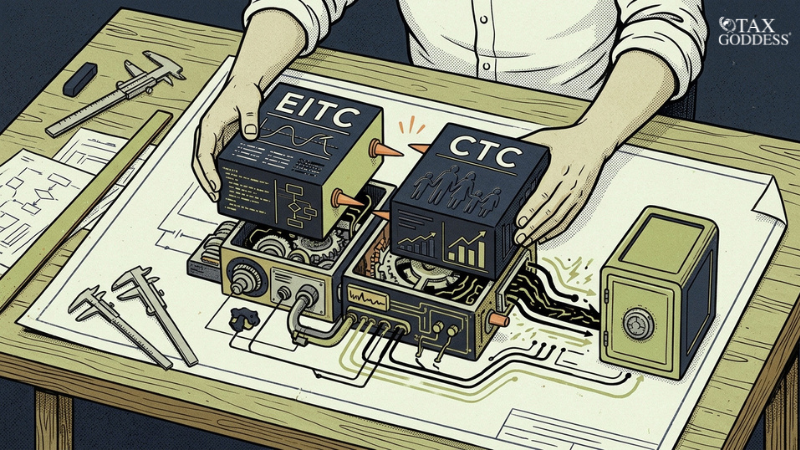
The Overview (TL;DR)
- The Earned Income Tax Credit (EITC) is a fully refundable wage subsidy designed for low-to-moderate-income workers, offering up to $8,231 for the 2026 tax year depending on family size.
- The Child Tax Credit (CTC) provides up to $2,200 per qualifying child under age 17, with phase-outs beginning at $200,000 for single filers and $400,000 for married couples filing jointly.
- Taxpayers meeting both income and dependency criteria can claim both credits on a single tax return to maximize their total refund.
- Selecting the proper filing status for EITC is essential, as Married Filing Separately generally blocks eligibility.
- Integrating these credits into proactive tax planning helps business owners and high earners structure family compensation, optimize tax strategy, and accelerate long-term wealth building.
No business owner or investor ever woke up and thought, “I can’t wait to hand Uncle Sam an extra chunk of my hard-earned revenue this year!” Yet, every tax season, millions of dollars in legitimate credits are left on the table simply because the rules seem like a maze wrapped in legalese.
With recent legislative shifts under the One Big Beautiful Bill Act (OBBBA) and new IRS inflation adjustments taking effect for the 2026 tax year, family tax credits have become more lucrative—and more nuanced—than ever. While you might assume provisions like the Earned Income Tax Credit and the Child Tax Credit are strictly for standard W-2 filers, high-net-worth individuals and business owners need to understand how they work. Whether you are structuring business payroll, assisting lower-earning family members, or managing divorced household custody arrangements, knowing how to leverage these tax credits is a fundamental piece of an intelligent tax strategy.
What Is the Earned Income Tax Credit?
It is a fully refundable federal benefit meant to reward work. Being “refundable” means that if the credit reduces your tax liability below zero, the IRS sends you the remaining balance as a direct cash refund.
For the 2026 tax year, maximum EITC benefit limits are adjusted for inflation:
- 3 or more qualifying children: Up to $8,231
- 2 qualifying children: Up to $7,316
- 1 qualifying child: Up to $4,427
- No qualifying children: Up to $664
The High-Net-Worth Trap: To qualify for the EITC, you must have earned income from active working wages or self-employment. However, the IRS enforces a strict investment income cap. For 2026, if you earn more than $12,200 in unearned investment income (capital gains, dividends, interest, or rental income), you are automatically disqualified from claiming the EITC, regardless of how low your earned wages might be.
What Is the Child Tax Credit?
The Child Tax Credit (CTC) is designed to cushion the financial cost of raising children. For 2026, the base credit delivers up to $2,200 per qualifying child under 17 years old.
Unlike the EITC, the primary CTC is nonrefundable—it reduces your income tax bill dollar-for-dollar down to zero. However, if your tax bill reaches zero and you still have credit left over, you may receive up to $1,700 per child through the refundable Additional Child Tax Credit (ACTC).
The CTC features generous phase-out thresholds:
- Single or Head of Household filers: Phase-out begins at $200,000 Modified Adjusted Gross Income (MAGI).
- Married Filing Jointly: Phase-out begins at $400,000 MAGI.
Because these thresholds are so high, many business owners and mid-to-high-income families still qualify for significant tax relief under the CTC.
Key Differences: EITC vs. CTC at a Glance
Understanding how these two major credits diverge helps you align them with your broader wealth building goals:
- Primary Purpose: The EITC is a work-focused wage subsidy for low-to-moderate earners. The CTC is a family tax relief credit accessible to middle- and upper-income households.
- Age Limits: EITC qualifying children can be under age 19 (or under 24 if a full-time student). CTC qualifying children must be under age 17 at the end of the tax year.
- Investment Limits: The EITC is capped at $12,200 in investment income for 2026. The CTC has no investment income ceiling.
- Refund Structure: The EITC is 100% refundable from the first dollar. The CTC is nonrefundable up to your tax bill, with up to $1,700 per child available as a refund through the ACTC.
How to Claim Both: Smart Tax Strategy for Families & Business Owners
Can you claim both the Earned Income Tax Credit and the Child Tax Credit on the same return? Absolutely. If your family structure and income meet the criteria for each, combining them yields maximum tax savings.
To claim both provisions seamlessly, keep these strategic rules in mind:
1. Choose the Correct Filing Status
Your choice of filing status for EITC can make or break your claim. Filing as Single, Head of Household, or Married Filing Jointly allows you to claim both credits if you qualify. However, if you choose Married Filing Separately, federal law generally bars you from receiving the EITC entirely, though narrow exceptions exist for legally separated spouses living apart.
2. Master Form Schedules and Documentation
To claim both credits, file Form 1040 along with two essential attachments:
- Schedule EIC: Details your qualifying children’s age, SSN, and residency for the EITC.
- Schedule 8812: Calculates your nonrefundable CTC and computes your refundable ACTC payout.
3. Leverage Shared-Custody Rules (Form 8332 Strategy)
For divorced or separated business owners sharing custody, federal tax law permits an asymmetric credit split. By executing IRS Form 8332, the custodial parent can release the claim for the Child Tax Credit to the non-custodial parent.
Crucially, Form 8332 does not transfer the Earned Income Tax Credit. The custodial parent retains the EITC and Head of Household status based on physical residency, while the higher-earning non-custodial parent uses the CTC to offset their higher tax liability. This tactical approach ensures no credit value is wasted.
4. Prepare for PATH Act Processing Timelines
By federal law, the IRS holds all tax refunds containing the EITC or Additional Child Tax Credit until mid-to-late February. Factoring this brief delay into your business cash flow and personal financial planning prevents early-year liquidity surprises.
Frequently Asked Questions
What is the main difference between the Earned Income Tax Credit and the Child Tax Credit?
The Earned Income Tax Credit is a refundable wage subsidy for low-to-moderate earners capped by investment income. The Child Tax Credit offers up to $2,200 per child for families earning up to $400,000, focusing broadly on child-rearing expenses.
Can I claim both the Earned Income Tax Credit and the Child Tax Credit?
Yes! If you satisfy the individual earning and dependent requirements for both programs, you can claim them together on Form 1040 using Schedule EIC and Schedule 8812. Combining both provisions maximizes your overall tax savings.
What is the best filing status for EITC eligibility?
Single, Head of Household, and Married Filing Jointly all preserve full access to the credit. Conversely, selecting Married Filing Separately generally disqualifies you from claiming the EITC under federal tax law, except under specific statutory separation rules.
How do tax credits fit into a broader tax planning and wealth building strategy?
Integrating credits into your proactive tax strategy reduces your net income tax bill. Lowering your tax burden keeps capital inside your business and personal accounts, freeing up vital cash flow for debt reduction, investments, and long-term wealth building.
What are the 2026 maximum limits for these tax credits?
For 2026, the maximum Earned Income Tax Credit ranges from $664 to $8,231 based on qualifying children. The Child Tax Credit provides up to $2,200 per child, with up to $1,700 available as a refundable refund.
Bottom Line
Navigating the intersection of family tax credits, filing statuses, and business income requires more than just filling out basic forms—it requires a coordinated tax plan. By structuring your filing status, business distributions, and dependent claims correctly, you can keep more money working for your business and family.
Tax laws are subject to change. This content is for educational purposes and does not constitute formal tax or legal advice.
STOP OVERPAYING THE IRS: GET STARTED WITH TAX GODDESS
Why leave your hard-earned money in the hands of the government when you could be reinvesting it into your business and wealth portfolio?
At Tax Goddess, we specialize in proactive, advanced tax strategy for business owners, entrepreneurs, and high-net-worth individuals. Our expert team has secured over $2.35 BILLION in tax savings for our clients by implementing legal, high-level tax strategies that standard accountants routinely overlook.
Ready to see how much you could save this year?