

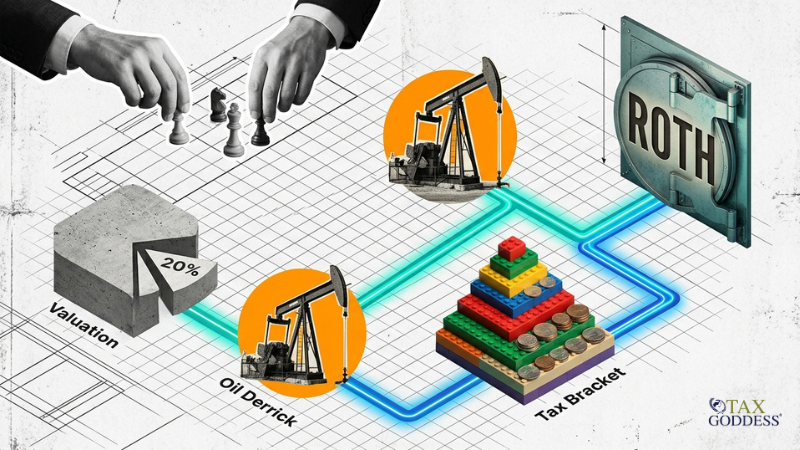
- Mitigate Front-End Valuation: By converting closely held assets held inside a self-directed IRA, you can apply independent valuation discounts to legally lower the taxable value of your conversion by 20% to 35%.
- Generate Offsetting Active Losses: Utilizing the domestic oil and gas working interest exception under IRC Section 469(c)(3) allows you to generate massive active ordinary losses. These first-year deductions can directly offset the ordinary income from your Roth conversion, potentially reducing your tax bill to zero.
- Navigate the 2026 Bracket Window: The passage of the One Big Beautiful Bill Act (OBBBA) permanently preserved the 37% top marginal tax bracket, offering high-net-worth investors a highly predictable landscape to map out phased, multi-year bracket-filling strategies.
For high-net-worth families, tax season often brings the sobering realization of how much of their hard-earned wealth is exposed to the IRS. If you have spent decades accumulating millions in traditional pre-tax retirement accounts, executing a standard Roth conversion can feel like accepting a massive, immediate 37% haircut on your wealth. However, elite wealth managers do not view taxes as an inevitability, but rather as an engineering challenge.
With the passage of the One Big Beautiful Bill Act (OBBBA), the tax landscape has become remarkably clear for sophisticated planners. The OBBBA permanently locked in the lower individual tax rates, ensuring the top marginal rate remains capped at 37%. More importantly, the legislation permanently restored the 100% bonus depreciation deduction under IRC Section 168(k), opening up powerful, immediate write-offs that can neutralize large-scale ordinary income.
Additionally, SECURE 2.0 rules mandate that catch-up contributions for employees earning over $150,000 must be made on an after-tax Roth basis. This statutory shift underscores a clear federal trajectory toward tax-free compounding accounts. By mastering the intersection of asset valuation discounts and active tax-shelter investments, you can execute a highly optimized conversion strategy that completely eliminates upfront tax friction.
Roth Conversion Tax Savings: Decoding the 2026 Tax Landscape for High-Net-Worth Converts
Before executing a conversion, you must understand exactly how your income will climb the graduated tax ladder. Because the ordinary income generated by a conversion is tacked directly onto your existing salary and investment gains, mapping your bracket margins is critical. Under the OBBBA, the 2026 graduated tax brackets are structured as follows (the standard deduction is established at $16,100 for Single filers, $32,200 for Married couples filing jointly, and $24,150 for Heads of household):
Single Taxpayers Bracket Breakdown:
- 10% Tax Rate: Applies to taxable income from $0 to $12,400.
- 12% Tax Rate: Applies to taxable income from $12,401 to $50,400.
- 22% Tax Rate: Applies to taxable income from $50,401 to $105,700.
- 24% Tax Rate: Applies to taxable income from $105,701 to $201,775.
- 32% Tax Rate: Applies to taxable income from $201,776 to $256,225.
- 35% Tax Rate: Applies to taxable income from $256,226 to $640,600.
- 37% Tax Rate: Applies to taxable income of $640,601 and above.
Married Couples Filing Jointly Bracket Breakdown:
- 10% Tax Rate: Applies to taxable income from $0 to $24,800.
- 12% Tax Rate: Applies to taxable income from $24,801 to $100,800.
- 22% Tax Rate: Applies to taxable income from $100,801 to $211,400.
- 24% Tax Rate: Applies to taxable income from $211,401 to $403,550.
- 32% Tax Rate: Applies to taxable income from $403,551 to $512,450.
- 35% Tax Rate: Applies to taxable income from $512,451 to $768,700.
- 37% Tax Rate: Applies to taxable income of $768,701 and above.
Heads of Household Bracket Breakdown:
- 10% Tax Rate: Applies to taxable income from $0 to $17,700.
- 12% Tax Rate: Applies to taxable income from $17,701 to $67,450.
- 22% Tax Rate: Applies to taxable income from $67,451 to $105,700.
- 24% Tax Rate: Applies to taxable income from $105,701 to $201,750.
- 32% Tax Rate: Applies to taxable income from $201,751 to $256,200.
- 35% Tax Rate: Applies to taxable income from $256,201 to $640,600.
- 37% Tax Rate: Applies to taxable income of $640,601 and above.
High-income earners must also account for the Alternative Minimum Tax (AMT). For the 2026 tax year, the AMT exemption is $90,100 for single taxpayers (phasing out at $500,000) and $140,200 for married joint filers (phasing out at $1,000,000). Because the OBBBA reduces this exemption by 50 cents for every dollar earned above these thresholds, large conversions can inadvertently trigger substantial AMT liabilities if left unmanaged.
How to Avoid Paying Taxes on a Roth IRA Conversion
Rather than writing a massive check to the Treasury, sophisticated strategists use a dual-force mechanism to achieve maximum Roth IRA conversion rules 2026 compliance and savings. First, we depress the reported value of the assets being converted on the front end. Second, we deploy capital into active ordinary loss-producing assets on the back end to erase the remaining taxable income.
Alternative Asset Valuation Discounts: Lowering the Front-End Bill
If you are converting cash, you are making a fundamental tactical error. By utilizing a Self-Directed IRA (SDIRA) to hold alternative assets—such as private equity, venture capital, closely held businesses, or real estate syndications – you can execute conversions during valuation “troughs”. Once converted, the asset’s recovery and future compound growth occur entirely tax-free.
Under Revenue Ruling 59-60, the IRS mandates that illiquid, private assets must be valued based on their fair market value (FMV) under a “willing buyer, willing seller” standard. This allows certified business appraisers to apply two major valuation discounts to minority interests:
- Discount for Lack of Control (DLOC): Reflects the reduced value of a minority share that cannot dictate business distributions, management, or exit decisions.
- Discount for Lack of Marketability (DLOM): Reflects the illiquidity and transaction costs associated with selling a private interest compared to public stock.
Rather than simply adding these discounts together, appraisers must compound them multiplicatively using the following formula:
Combined Discount = 1 – ((1 – DLOC) * (1 – DLOM))
For example, if an appraiser determines a 10% DLOC and a 20% DLOM are appropriate for your SDIRA’s minority interest in a real estate syndicate, the combined discount is computed as:
Combined Discount = 1 – (1 – 0.10) * (1 – 0.20) = 0.28 (or 28%)
If your pro-rata share of the underlying asset is $100,000, applying the 28% discount reduces the reported taxable conversion value to just $72,000. This instantly shields $28,000 of your wealth from federal income tax. To ensure IRS compliance and bypass Section 2703 restrictive covenant audits, you must secure a formal valuation from a credentialed appraiser (ASA or ABV).
Fully Insured Section 412(i) Plans and Safe Harbors
For business owners utilizing fully insured defined benefit pension plans funded exclusively with life insurance and annuity contracts, distributing these contracts to execute a Roth conversion requires navigating strict valuation safe harbors. To prevent “springing cash value” abuses, the IRS issued Revenue Procedure 2005-25. Under these guidelines, the FMV of a distributed non-variable contract is determined by the greater of two specific metrics:
Fair Market Value = Maximum of (Adjusted ITR) or (PERC Amount multiplied by Average Surrender Factor)
- Adjusted Interpolated Terminal Reserve (ITR): Calculated as the reserve value of the policy plus unearned premiums and expected dividends: Adjusted ITR = ITR + Unearned Premium + Pro-Rata Expected Dividends
- Adjusted PERC Amount: The aggregate of premiums, dividends, and earnings, minus charges and distributions: PERC = Premiums Paid + Dividends Applied + Other Earnings – Reasonable Charges – Distributions
By utilizing these precise formulas, wealth managers can safely convert insurance-based retirement assets while maintaining absolute regulatory compliance.
Erasing the Rest with the Intangible Drilling Costs Tax Deduction
Once you have discounted the taxable value of your conversion on the front end, you can completely erase the remaining tax bill using the intangible drilling costs tax deduction. The U.S. tax code actively incentivizes domestic energy independence by providing unmatched tax relief to those who finance drilling programs.
Under IRC Section 263(c), Intangible Drilling Costs (IDCs) (the non-salvageable expenses of drilling a well, such as labor, fuel, site preparation, chemicals, and hauling) can be fully deducted in the year they are incurred. These expenses typically comprise 65% to 80% of a well’s total budget.
Furthermore, because the OBBBA permanently restored 100% bonus depreciation under Section 168(k), the Tangible Drilling Costs (TDCs) – salvageable hardware like wellheads, casing, and storage tanks – are also fully deductible in Year 1. This allows qualified investors to write off nearly 100% of their total energy deployment immediately.
The Power of the Section 469(c)(3) Passive Activity Exception
Under normal tax rules, investment losses are deemed passive and cannot offset active ordinary income like W-2 wages or business profits. However, Section 469(c)(3) provides an exclusive statutory exception for oil and gas working interests.
Crucial Structure Rule: To claim this exception, you must hold the working interest directly as an individual (sole proprietorship) or through an entity that does not limit your liability (such as a General Partnership). Holding a working interest through a limited partnership (as a limited partner) or any form of LLC will completely disqualify you from the exception, turning your active shield into a restricted passive loss.
When structured properly via a General Partnership or direct title, your drilling losses are automatically classified as active ordinary losses. This requires zero active hours of participation, completely bypassing the restrictive tests associated with real estate professional status (REPS). These active ordinary deductions flow directly onto your Schedule E to offset the taxable income generated by your Roth conversion.
Independent Producers vs. Integrated Oil Companies
To capture the maximum tax benefit, your investment must be structured through an independent producer rather than a major integrated oil company. The tax code maintains strict distinctions between the two:
- Independent Producers: Defined as companies with average daily production under 1,000 barrels and no major retail or refining operations. They are legally permitted to immediately deduct 100% of their domestic IDCs in Year 1.
- Integrated Oil Companies: Large, multi-tier energy corporations are restricted to immediately deducting only 70% of their IDCs, while the remaining 30% must be capitalized and amortized over 60 months.
Managing AMT via Section 59(e) Amortization Elections
While immediate expensing under Section 263(c) maximizes regular tax relief, accelerated IDCs represent an AMT tax preference item under Section 57(a)(2). This means your “excess IDCs” are added back to your Alternative Minimum Taxable Income (AMTI) on Form 6251. The excess IDC is calculated as:
Excess IDC = IDCs Deducted – 120-Month Amortization
This excess becomes a preference item to the extent it exceeds 65% of your net income from all oil and gas properties for the year. If your AMTI exceeds the 2026 AMT exemptions ($90,100 for singles; $140,200 for joint filers) and triggers the AMT, it can erode up to 30% of your net tax benefit.
To completely neutralize this risk, you can make a flexible Section 59(e) amortization election on Form 4562. This allows you to capitalize and amortize all or a specific portion of your IDCs over a 60-month period, which entirely eliminates those electing portions from the AMT preference calculation.
An elite advisor will implement a “split-election” strategy. By immediately expensing IDCs under Section 263(c) up to your exact AMT threshold, and amortizing the remaining balance over 60 months via Section 59(e), you perfectly maximize your tax savings while avoiding the AMT trap.
Frequently Asked Questions
How can I LEGALLY avoid taxes on a Roth IRA conversion?
You can offset the ordinary income generated by your conversion by investing in domestic oil and gas working interests. When held directly or via a general partnership under IRC Section 469(c)(3), these generate active ordinary losses from intangible drilling costs that can legally reduce your taxable conversion income to zero.
Does a Roth conversion make sense in 2026?
Yes, absolutely. With the One Big Beautiful Bill Act permanently locking in the top marginal bracket at 37%, executing a conversion now provides a highly predictable window. Converting today ensures all future compounding growth escapes income taxes permanently.
How do 2026 tax brackets affect my retirement account conversion?
Converted funds are added directly to your taxable income, potentially pushing you into higher brackets. Because 2026 tax brackets are graduated, strategically mapping conversions up to your marginal bracket ceiling ensures you capture massive savings without triggering prohibitive tax rates.
What are the primary Roth IRA conversion rules for 2026?
Unlike standard contributions, there are no income or contribution limits on Roth conversions. You can convert unlimited pre-tax retirement assets, but must recognize the converted balance as taxable ordinary income in the year of execution, requiring advanced offset strategies.
Bottom Line
The 2026 tax landscape under the OBBBA provides a unique, highly structured window for high-net-worth individuals to permanently shield their wealth through strategic Roth conversions. By combining alternative asset valuation discounts with immediate energy-sector active ordinary deductions, you can transfer millions of dollars into tax-exempt vehicles without sacrificing your current liquidity. However, executing these sophisticated maneuvers requires flawless compliance, precise math, and qualified professional coordination.
Disclaimer: Tax laws are subject to change. This content is for educational purposes and does not constitute formal tax or legal advice. Always consult with a qualified tax professional regarding your specific situation before implementing any strategies.
Minimize Your Tax Bill with Tax Goddess
Are you ready to stop letting the IRS act as the majority partner in your retirement wealth? At Tax Goddess, we specialize in high-net-worth tax reduction and advanced asset sheltering, having successfully saved over $2 BILLION in taxes for our clients.
If you need help with avoiding taxes legally and keeping more money in your pocket, let’s talk.