
The Overview (TL;DR)
- Tax-deductible life insurance is possible, just not the usual way. Your business can’t deduct a policy you buy on your own.
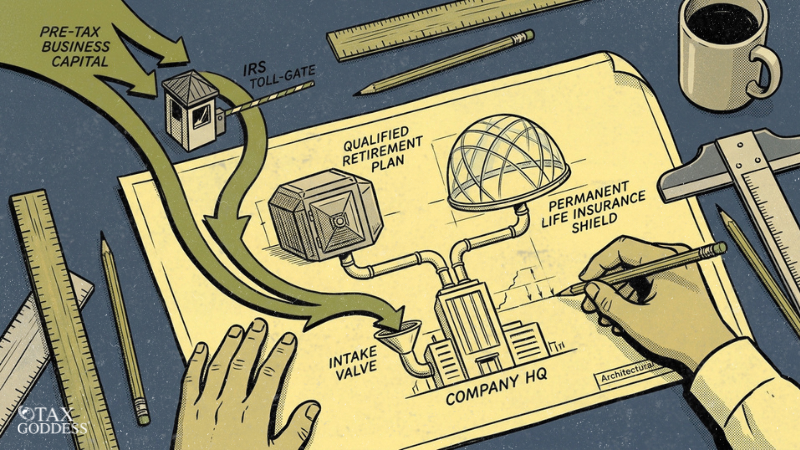
- Here’s how it works: your business puts money into a retirement plan and deducts it. The plan then uses part of that money to buy life insurance on you.
- There’s a size limit. Whole life can use just under half of the money put in for you. Other types can use just under a quarter.
- You pay a little tax each year. It’s a small amount, not tax on the full premium.
- Your family gets the insurance part of the payout free of income tax. The part that equals the policy’s savings (its cash value) is taxed.
- The cash value grows tax-deferred. No yearly tax while the policy is in the plan.
- You need an exit plan. The policy has to leave the plan before you retire.
- Estate tax can still apply. A special trust can help once the policy leaves the plan.
- Best for: owner-only and family businesses with big, steady profits.
Here’s how most business owners buy life insurance.
Your business earns a dollar. The IRS takes its cut. Then you pay the insurance company with what’s left.
That means you’re paying for your policy with money that’s already been taxed. It’s like paying a toll to drive on your own driveway.
And it adds up fast. In the top 37% tax bracket, a $62,500 yearly premium can eat up about $100,000 of your earnings once state taxes join in.
Those tax rates are here to stay, too. A 2025 tax law, the One Big Beautiful Bill Act, made today’s rates permanent, including the 37% top rate. The IRS also raised retirement plan limits for 2026.
That’s good news for one strategy: tax-deductible life insurance through a retirement plan. It’s not a loophole. It’s in the tax code and has been for decades.
The IRS does keep an eye on it. In 2004, it cracked down on people who abused it with oversized policies. So doing it by the book matters.
This guide covers how it works, who it’s for, the 2026 numbers and the mistakes to avoid. All in plain English.
How Does Tax-Deductible Life Insurance Work?
The idea is simple:
- Your business sets up a retirement plan that allows life insurance.
- Your business puts money into the plan each year and deducts it.
- The plan uses part of that money to buy a permanent life insurance policy on you.
- The rest is invested for your retirement, as usual.
- You pay a small amount of tax each year for the insurance coverage.
- Before you retire, the policy leaves the plan. More on that later.
What kind of retirement plan do you need?
It has to be a “qualified” plan. That’s IRS-speak for an employer retirement plan that follows federal rules. These can work:
- Defined benefit plans and cash balance plans. These allow the biggest deductions, especially for owners in their 40s, 50s and 60s. The catch: you must fund them every year.
- Profit-sharing plans. These give you more freedom to change how much you put in each year.
- Solo 401(k) plans. Sometimes. Many standard plans don’t allow insurance, so you may need a custom one.
What doesn’t work?
IRAs. The law bans IRAs from owning life insurance. That includes SEP-IRAs and SIMPLE IRAs. If you use a SEP today, you’d need a different plan for this strategy.
What kind of life insurance?
Permanent life insurance. It lasts your whole life and builds savings, called cash value. Common types include whole life, universal life, indexed universal life (IUL) and variable universal life (VUL).
Why does the IRS allow this?
The IRS allows insurance in a retirement plan as long as it stays a small part of the plan. Think of it this way: retirement is the main course. Insurance is the side dish. The next section shows how big that side dish can be.
How Much of Your Retirement Money Can Go to Life Insurance?
The IRS limits the insurance part. Here are the basic rules:
- Whole life: less than 50% of the money your business puts in for you.
- Universal life, IUL or VUL: less than 25%.
- Older profit-sharing money: money that has been in a profit-sharing plan for two years or more can often buy more insurance, if the plan allows it.
- Defined benefit plans: your plan administrator may use a different test. It caps the payout at 100 times your expected monthly pension.
Quick example: say your business puts $100,000 into a plan for you. Just under $25,000 could go to an IUL policy. Or just under $50,000 could go to whole life. The rest stays invested for retirement.
The 2026 IRS limits you should know
These limits decide how much your business can put in. That decides how much insurance the plan can buy.
- $360,000: the most salary a plan can count when figuring your benefit.
- $290,000: the largest yearly pension a defined benefit plan can aim for. This is what makes big deductions possible.
- $72,000: the most that can go into a profit-sharing or 401(k) plan for one person each year, before catch-up contributions.
- $24,500: the most you can put into a 401(k) from your own paycheck.
- $8,000: extra catch-up room if you’re 50 or older. It’s $11,250 if you’re 60 to 63.
- $150,000: if your 2025 wages topped this, your 2026 catch-up contributions must go in as Roth (after-tax).
- $15 million: how much each person can leave before federal estate tax kicks in. Above that, the rate is 40%.
- $19,000: how much you can give each person each year without touching your $15 million limit.
Notice the gap between $72,000 and $290,000. That’s why defined benefit and cash balance plans do the heavy lifting here. For an owner in their 50s, they can often support a deduction well over $100,000 a year. Your plan actuary, the person who runs the math, sets the exact number.
What Gets Taxed, and When?
This strategy moves taxes in your favor. It doesn’t make them disappear. Here’s the simple version.
Today
- Your business deducts the full amount it puts into the plan. That includes the part that pays for the insurance.
- You pay tax on a small amount each year. The IRS sets it using a chart based on your age and coverage. It’s usually much less than the premium.
- That yearly amount isn’t wasted. It generally counts in your favor later, lowering your tax when the policy leaves the plan.
While you’re alive: tax-deferred cash value growth
The policy’s cash value grows inside the plan with no yearly tax. Over 10 or 20 years, that adds up. It’s a quiet but powerful wealth-building tool.
When you pass away
- The insurance part is free of income tax. That’s the payout minus the cash value.
- The cash value part is taxed, just like any other retirement plan payout.
- The whole policy counts toward your estate. Most families are under the $15 million limit. Bigger estates may owe 40% on the amount above it.
Bottom line: “tax-free” here means free of income tax on the insurance part. It doesn’t mean free of every tax. Remember that if anyone pitches this to you.
3 Real-Life Examples
Think of this like chess. The plan rules are your pawns. Use them well, and they protect your queen: your family’s wealth.
Example 1: The solo consultant
Who: A consultant whose S corporation earns $1.2 million a year. She’s in the top tax bracket. She wants to save $250,000 a year for retirement. She also needs permanent life insurance.
The old way: She pays a $62,500 yearly premium out of her own pocket. After taxes, that costs her about $100,000 of earnings.
The better way:
- Her CPA sets a fair salary for her, up to the $360,000 limit.
- She opens a defined benefit plan. Her business puts in $250,000 a year, as figured by the plan’s actuary.
- Up to 25% of that, or $62,500, buys an IUL policy inside the plan.
- Her business deducts the full $250,000. That puts off up to about $92,500 in federal income tax this year.
Example 2: The family real estate firm
Who: Two siblings own a real estate firm that earns $3 million a year. Only family works there.
The goal: Big tax deductions now. Money for their kids later.
The better way: They set up a cash balance plan. The plan buys a whole life policy on each sibling, using less than 50% of what’s put in for them. The firm deducts the full amount. When each sibling passes away, the insurance part goes to their kids free of income tax.
One heads-up: the cash value is still taxed when it comes out of the plan. And if either sibling’s estate could top $15 million, they should plan to move the policies into a special trust later.
Example 3: The tech founder with an old retirement account
Who: A founder has $800,000 in an old employer’s profit-sharing plan. He now runs a one-person AI startup. He wants permanent life insurance without draining his cash.
The trap: Cashing out means income tax plus a 10% penalty if he’s under 59½. Moving the money to an IRA won’t help either, since IRAs can’t own life insurance.
The better way:
- His CPA and a retirement plan attorney set up a custom profit-sharing plan that allows insurance.
- He moves the old money straight into the new plan. Not into an IRA first.
- His plan administrator checks how much can buy insurance. Usually that’s under 25% for IUL or under 50% for whole life. Money that’s been in a profit-sharing plan for two-plus years may allow more.
- When the policy leaves the plan later, it must be valued using IRS rules for fair market value.
The Exit Plan: Where the Real Wealth Building Happens
The policy can’t stay in a defined benefit plan forever. It has to come out before you retire or the plan closes. How it comes out decides most of your tax result.
Your 3 main options
- Buy the policy from the plan. You pay the plan what the policy is worth. That money stays in your retirement account, and you now own the policy. This is the most popular choice.
- Take the policy out as a payout. The plan hands you the policy. You pay income tax on its value that year.
- Cash it in inside the plan. The plan cancels the policy, and the cash stays in your retirement account. You lose the coverage.
Option 1 opens the door to two big benefits.
Tax-free retirement income with life insurance loans
Once you own the policy, you can borrow against its cash value. These loans generally aren’t taxed. That can make them a source of tax-free retirement income.
It only works if:
- The policy wasn’t overfunded. The IRS calls an overfunded policy a “modified endowment contract,” or MEC. Loans from a MEC can be taxed.
- The policy stays active until you pass away. If it lapses with a big loan on it, you could owe tax all at once.
- You review it every year with your insurance advisor.
One important note: this only works after the policy leaves the plan. While the plan owns it, you can’t borrow the cash value for personal use.
How to avoid estate tax with life insurance
A policy owned by you or your plan counts toward your estate. If your estate tops $15 million, up to 40% of the payout could go to estate tax.
The fix is an irrevocable life insurance trust, or ILIT. It’s a trust that owns the policy for your family.
ILIT tax advantages:
- The payout stays out of your estate, so estate tax doesn’t touch it.
- Your family gets cash fast to pay taxes or keep the business running.
- You set the rules for how the money is used. That can protect your heirs from creditors, divorce or overspending.
- You can fund it with yearly gifts of up to $19,000 per family member, without using your $15 million limit.
Timing matters. If you give an existing policy to an ILIT and pass away within three years, it counts toward your estate anyway. How the policy is sold also matters, or the payout could become taxable. Your estate attorney and plan attorney should handle this step together.
Is This Right for You?
This strategy works great for some businesses and poorly for others.
It’s a good fit if you:
- Own a business with no employees, or only family employees
- Expect big, steady profits for years to come
- Are in your 40s, 50s or 60s
- Truly need permanent life insurance for your family, business or estate
- Have a large estate and want to plan ahead
It’s probably not a fit if you:
- Have several employees. IRS fairness rules may make you cover them too, which raises your costs.
- Have up-and-down income. Defined benefit plans need money every year, even in slow years.
- Only need term insurance. Permanent coverage costs more, so it only makes sense if you’ll keep it.
- Have health issues that make coverage costly or hard to get.
Common mistakes to avoid
- Putting insurance in an IRA or SEP. It’s not allowed.
- Going over the 25% or 50% limits. That can put your whole plan at risk.
- Skipping the yearly tax on the insurance. The plan reports it to you on Form 1099-R.
- Buying a policy that’s too big. This is what the IRS cracked down on in 2004.
- Having no exit plan. A rushed exit can mean a surprise tax bill.
- Thinking “income-tax-free” means “estate-tax-free.” Only estate planning, like an ILIT, handles estate tax.
- Using a basic plan that doesn’t allow insurance.
Good tax planning here takes a team: your CPA, a plan administrator, a plan actuary (for defined benefit plans) and a licensed insurance advisor.
Frequently Asked Questions
Is life insurance tax deductible for business owners?
Not if you buy it yourself. But your business can deduct money it puts into a qualified retirement plan. The plan can then use part of that money to buy permanent life insurance on you. That’s how tax-deductible life insurance works.
Can an IRA or SEP-IRA own life insurance?
No. The law bans all IRAs from owning life insurance, including SEP-IRAs and SIMPLE IRAs. You need a qualified plan instead, like a defined benefit, cash balance or profit-sharing plan.
How much of my retirement contribution can buy life insurance?
Less than 50% for whole life. Less than 25% for universal, indexed or variable universal life. Money that’s been in a profit-sharing plan for two years or more may allow more, if your plan permits it.
Is the death benefit taxable?
The insurance part, which is the payout minus the cash value, is free of income tax. The cash value part is taxed like a retirement plan payout. The whole policy also counts toward your estate.
Does cash value grow tax-deferred in a retirement plan?
Yes. You don’t pay tax on the growth each year while the policy is in the plan. Tax comes later, depending on how the policy leaves the plan.
Can life insurance loans give me tax-free retirement income?
Yes, once you own the policy after it leaves the plan. Policy loans generally aren’t taxed if the policy isn’t overfunded and stays active until you pass away. If it lapses with a big loan, you may owe tax.
How do I avoid estate tax with life insurance?
Have an irrevocable life insurance trust (ILIT) own the policy. Then the payout stays out of your estate. If you give an existing policy to the trust, you need to live three more years for this to work.
What are the tax advantages of an irrevocable life insurance trust?
An ILIT keeps the payout out of your estate, so it avoids the 40% estate tax. You can fund it with yearly gifts of up to $19,000 per person. It also gives your family fast cash and clear rules for using it.
What happens to the policy when I retire?
It has to leave a defined benefit plan. You can buy it from the plan, take it as a taxable payout, or cash it in and keep the money in your plan. Plan this from day one.
Does this work if I have employees?
It can, but it costs more. IRS fairness rules may require you to give your employees benefits too. That’s why owner-only and family businesses get the most out of it.
Is this legal?
Yes. The tax code allows life insurance in retirement plans if it stays a small part of the plan. The IRS has cracked down on abuse, so work with a CPA, plan administrator and licensed advisor who follow the rules.
How does this help with tax planning and wealth building?
It turns a personal, after-tax expense into a business tax deduction. The cash value grows tax-deferred. Your family gets an income-tax-free payout. Add a smart exit plan and an ILIT, and it becomes a long-term wealth builder.
Bottom Line: Stop Paying for Life Insurance the Hard Way
Most business owners pay for life insurance with money that’s already been taxed. Tax-deductible life insurance flips that.
Your business gets a deduction. Your cash value grows tax-deferred. Your family gets an income-tax-free payout on the insurance part.
Just play by the rules. Stay under the limits. Pay the small yearly tax. Plan your exit early. And if estate tax is a concern, add an ILIT.
For owner-only and family businesses with strong profits, few strategies do this much. Just make sure the right team sets it up.
Tax laws are subject to change. This content is for educational purposes and does not constitute formal tax or legal advice.
Ready to Stop Overpaying? Talk to Tax Goddess
Tax Goddess has helped clients save more than $2.43 billion in taxes.
In a free consultation, we’ll look at your business, your retirement plan and your insurance needs. Then we’ll tell you:
- Whether tax-deductible life insurance is right for you
- How much you could deduct in 2026
- What your exit plan should look like
No jargon. No pressure. Just a clear plan.