
The Overview (TL;DR)
- Controlled Group Retirement Plan Stacking is an advanced tax strategy that layers a Defined Benefit or Cash Balance pension plan on top of a Defined Contribution plan (such as a 401(k) or prototype SEP) across related business entities to generate $300,000+ in annual pre-tax deductions.
- It moves past standard retirement ceilings, enabling high-earning business owners to bypass the standard 2026 Defined Contribution limit of $72,000 ($80,000 with catch-up) by utilizing the 2026 Defined Benefit limit of $290,000.
- Multi-entity businesses must navigate controlled group IRC 414 rules, which treat businesses with common ownership as a single employer to prevent excluding rank-and-file employees from plan benefits.
- The strategy is unlocked using the IRC 404 (a) (7) 6 percent rule, a statutory carve-out that allows employers to fund a full Defined Benefit contribution alongside an employer profit-sharing contribution capped at 6% of compensation without triggering combined deduction penalties.
- While a Defined Benefit SEP IRA combination is legally permissible, pairing a Cash Balance plan with standard IRS Form 5305-SEP invalidates the SEP; business owners must use custom prototype documents or, far better, a Safe Harbor 401(k) to preserve personal salary deferrals.
Congratulations: your business had an outstanding year, grossing well over $1,000,000.
Then you get the dreaded year-end call from your CPA. Uncle Sam wants a cut so large it could fund a mid-sized municipal transit authority.
When you ask how to protect your hard-earned profits, standard tax preparers offer the usual advice: “Go max out your SEP IRA or Solo 401(k)!”
While sheltering $72,000 under the 2026 annual additions cap is a start, if your taxable business net is sitting at $500,000 or $700,000, a $72,000 deduction is like putting a single band-aid on a broken leg. You are still handing over six figures in unnecessary federal and state income taxes.
Taxes are a strategic chess game, not a game of chance. High-net-worth entrepreneurs do not rely on standard retail retirement plans. Instead, they deploy Controlled Group Retirement Plan Stacking. By combining corporate structuring under IRC Section 414 with advanced pension mechanics under IRC Section 404(a)(7), you can legally wipe out $300,000 or more in taxable income every single year.
Here is how high-earning business owners can turn complex IRS rules into their most powerful wealth-building asset.
Cracking the Code: What Is Cash Balance Plan Stacking?
To save real money, you have to understand the difference between the two main types of IRS retirement plans:
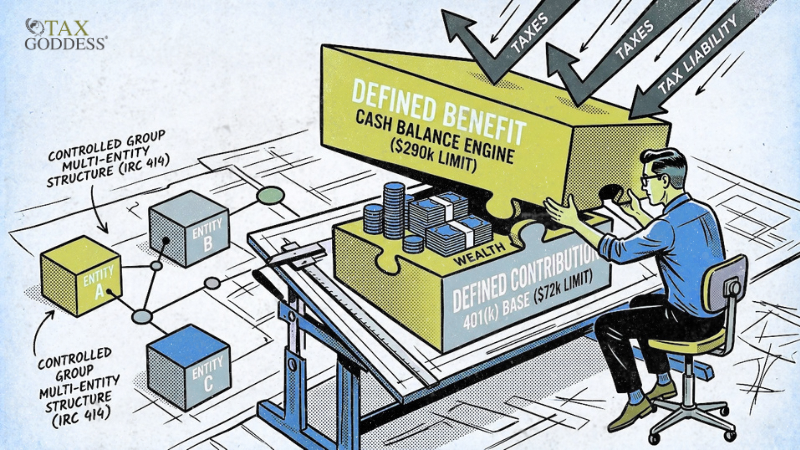
- Defined Contribution (DC) Plans: Plans like 401(k)s and SEP IRAs where the IRS caps the amount of money you can put in each year. For 2026, the absolute ceiling under IRC Section 415(c) is $72,000.
- Defined Benefit (DB) Plans: Traditional pensions and Cash Balance plans where the IRS caps the future benefit you can take out at retirement, rather than what you put in today. Under IRC Section 415(b), the maximum annual retirement benefit is capped at $290,000 for 2026.
Cash balance plan stacking simply means building a multi-tiered retirement structure. An actuary calculates how much cash your business must deposit today to fund that statutory $290,000 annual lifetime annuity at retirement age. For owners in their 40s, 50s, or 60s, that required contribution frequently lands between $150,000 and $350,000+ per year.
When you stack that Cash Balance tier on top of a 401(k) profit-sharing chassis, you secure a massive high-income retirement tax deduction that turns current tax liabilities into personal, protected net worth.
Controlled Group IRC 414: Why You Cannot Just Hide Your Staff
A common question among serial entrepreneurs is: “Can I put a massive Cash Balance plan in my consulting company where I am the only worker, and keep my retail operating business and its 15 employees separate?”
The short answer: No.
Under controlled group IRC 414 rules, the IRS looks straight through separate corporate veils and treats related businesses as a single employer. If your businesses fall into one of these buckets, all employees across every company must be factored into plan testing:
- Parent-Subsidiary Groups: One company owns at least 80% of another company (reduced to more than 50% when testing retirement contribution limits under IRC Section 415(h)).
- Brother-Sister Groups: Five or fewer individuals own at least 80% of each entity and maintain more than 50% identical ownership across both companies.
- Family Attribution Rules: You cannot escape these rules by putting a second business in your spouse’s or minor child’s name; the IRS automatically treats that stock as owned by you unless strict statutory non-involvement conditions are met.
Failing to analyze controlled groups can lead to plan disqualification, retroactive loss of deductions, and steep excise taxes. However, working with a strategic advisor allows you to design cross-tested plans that provide modest, legally required benefits to your employees while directing 85% to 90%+ of total plan dollars straight into your personal account.
The Secret Weapon: The IRC 404 (a) (7) 6 Percent Rule
If you set up both a Defined Benefit plan and a Defined Contribution plan, you will run directly into IRC Section 404(a)(7).
Under normal rules, when an employer offers both types of plans, total tax deductions across both are capped at 25% of eligible payroll. In a small business, a Cash Balance plan alone frequently requires 25% or more of your payroll. Under normal limits, that would completely eliminate your ability to make profit-sharing contributions in your 401(k).
This is where the IRC 404 (a) (7) 6 percent rule (IRC Section 404(a)(7)(C)(iii)) comes into play:
- If your employer Defined Contribution (profit-sharing) allocation does not exceed 6% of eligible compensation, the 25% combined plan limit does not apply.
- Employee elective salary deferrals (your personal 401(k) salary contribution) do not count toward this 6% cap.
- The Result: You can deduct 100% of your large actuarial Cash Balance plan contribution, plus an employer profit-sharing contribution up to 6% of pay, plus your full employee 401(k) deferrals.
Defined Benefit SEP IRA Combination vs. Safe Harbor 401(k): Watch the Trap
Many business owners start with a SEP IRA because it is simple to set up at a retail brokerage. But when attempting a Defined Benefit SEP IRA combination, a major trap exists.
- The Model SEP Trap: Over 90% of small business SEP IRAs use IRS Form 5305-SEP. The operational instructions of Form 5305-SEP state that you cannot maintain a SEP IRA if you have ever maintained another qualified plan (including a Defined Benefit or Cash Balance plan). Stacking a Cash Balance plan with a standard Form 5305-SEP invalidates the SEP, creating an operational defect.
- The Prototype Workaround: To pair these plans, you must establish an individually designed or prototype SEP document under IRC Section 404(h)(3).
- Why the 401(k) Wins: Even if you use a prototype SEP, SEPs do not allow employee salary deferrals. By pairing your Cash Balance plan with a Safe Harbor 401(k) instead, you can contribute an additional $24,500 (or $32,500 if age 50+) in salary deferrals on top of your 6% profit-share and Defined Benefit contributions.
The $1,000,000 Revenue Blueprint: 2026 Stacking in Action
How do the official 2026 defined benefit limits look on a tax return?
Consider a 52-year-old business owner operating an incorporated advisory practice grossing $1,200,000 annually. The owner draws an S Corporation W-2 salary of $360,000 (the maximum allowable compensation limit under IRC Section 401(a)(17) for 2026) and employs two team members with a combined payroll of $120,000.
The stacked plan is built in three distinct layers:
- Tier 1 (Cash Balance Plan): The enrolled actuary calculates a benefit formula targeting the 2026 Section 415(b) ceiling. At age 52, this allows a $260,000 annual contribution credit for the owner. To satisfy minimum participation rules under IRC Section 401(a)(26), the two staff members participate, receiving an aggregate defined benefit contribution of $10,000.
- Tier 2 (401(k) Salary Deferrals): The owner maximizes elective salary deferrals under IRC Section 402(g) at $24,500, plus the age-50 catch-up contribution of $8,000, for a total personal salary deferral of $32,500. These employee salary deferrals do not count toward the 6% limit under Section 404(a)(7)(C)(iii). Staff contributes zero elective deferrals here.
- Tier 3 (Safe Harbor and 6% Profit-Sharing): To optimize defined contribution additions without triggering combined deduction limits, the company funds an employer contribution capped at exactly 6% of eligible pay. The owner receives $21,600 ($360,000 multiplied by 6%). The staff receives $28,000 in combined safe harbor non-elective and cross-tested gateway allocations to satisfy nondiscrimination testing.
The combined bottom line for the business:
- Owner Total Allocation: $260,000 (Cash Balance) + $32,500 (Salary Deferral) + $21,600 (6% Profit-Sharing) = $314,100.
- Staff Personnel Total Allocation: $10,000 (Cash Balance) + $28,000 (Safe Harbor & Gateway) = $38,000.
- Total Business Pre-Tax Deduction: $352,100.
By executing this stacked structure, the company writes off $352,100 in pre-tax business income, while $314,100 (89.2% of every dollar contributed) goes directly into the business owner’s personal retirement accounts. Assuming a combined 40% federal and state marginal tax bracket, the owner keeps over $140,000 in cash that would have otherwise gone directly to the IRS.
Frequently Asked Questions
What are IRS Controlled Group rules under IRC Section 414?
IRC Section 414 treats separate businesses with common ownership as a single employer. This prevents business owners from splitting companies to give themselves large retirement contributions while excluding rank-and-file employees in affiliated entities from retirement coverage and nondiscrimination protections.
How does pairing a Defined Benefit plan with a SEP IRA work?
Pairing these plans requires an individually designed prototype SEP rather than a standard IRS Form 5305-SEP. Under IRC Section 404(h)(3), employer SEP contributions are limited to 6% of compensation to avoid triggering combined deduction caps that reduce the defined benefit deduction under Section 404(a)(7).
What is the 6% rule under IRC Section 404(a)(7)?
Under IRC Section 404(a)(7)(C)(iii), if an employer’s Defined Contribution allocations do not exceed 6% of participant payroll, the 25% combined deduction cap does not apply. The employer can deduct 100% of the Defined Benefit contribution alongside the 6% defined contribution profit-sharing allocation.
What is the maximum Defined Benefit plan limit for 2026?
Under IRC Section 415(b)(1)(A), the 2026 maximum annual benefit payable at retirement is $290,000. Depending on the participant’s age and actuarial assumptions, this allows an annual tax-deductible contribution between $150,000 and $350,000 or more.
Can I have a SEP IRA and a Cash Balance plan at the same time?
Yes, but only by using a prototype or custom SEP document. Standard IRS Form 5305-SEP prohibits maintaining any other qualified plan. However, most business owners prefer a Safe Harbor 401(k) to preserve personal employee salary deferrals.
How can a business owner contribute more than $72,000 to a retirement plan?
By stacking a Defined Benefit or Cash Balance plan on top of a 401(k). While defined contribution plans cap annual additions at $72,000 in 2026, defined benefit structures allow additional actuarial contributions of $200,000 or more.
Bottom Line
Controlled group retirement plan stacking transforms complex tax code constraints into a structured wealth-building vehicle. By coordinating corporate entities, complying with single-employer rules under IRC Section 414, and utilizing the Section 404(a)(7) 6% safe harbor, business owners grossing $1,000,000+ can shelter over $300,000 in income each year while rewarding valued employees.
Disclaimer: Tax laws are subject to change. This content is for educational purposes and does not constitute formal tax or legal advice.
Take Control of Your Tax Strategy with Tax Goddess
Are you tired of handing over massive chunks of your hard-earned profits to the IRS every quarter?
At Tax Goddess, we view tax planning as a high-stakes chess match—and we play to win. Our team of elite tax strategists, CPAs, and retirement architects has helped entrepreneurs, medical professionals, and high-net-worth business owners secure over $2.41 BILLION in verified tax savings.
Stop settling for basic tax returns that only report what you owe. Start implementing proactive strategies that legally minimize your tax burden and accelerate personal wealth.